
Review
No Man's Sky in 2026 — Ten Years Later, the Promised Universe Finally Exists

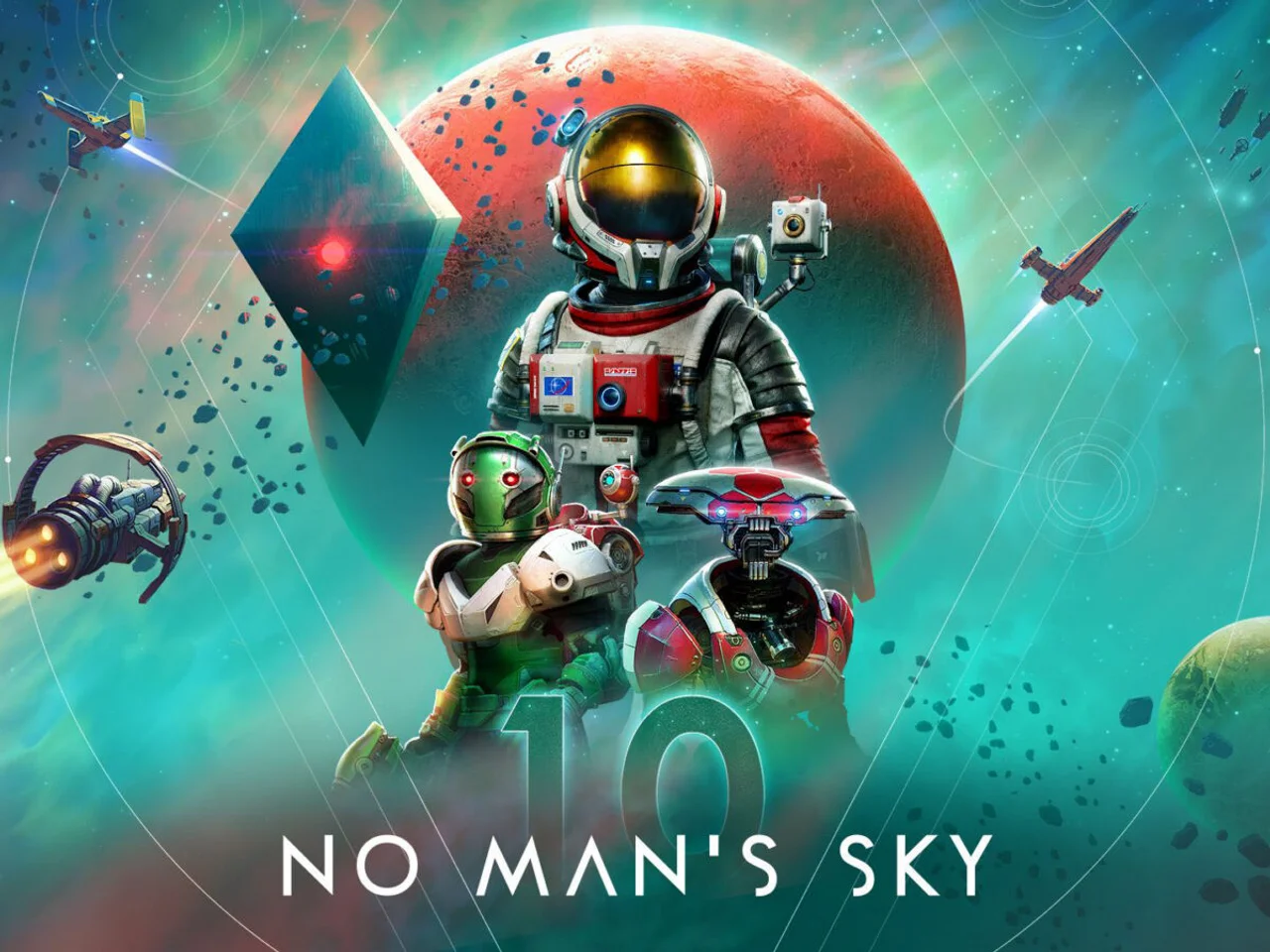
No Man's Sky is no longer merely a procedural exploration game. Base building, settlements, habitable ships, community expeditions, creature training and space wars have accumulated for ten years without erasing its simplest pleasure: landing somewhere simply to see what lies beyond the hill.
No Man's Sky still begins with a stranger waking on an alien planet, repairing broken equipment and looking toward a star that can genuinely be reached.
What changed over ten years is everything the player can decide to do before leaving.
The 2016 game is still buried underneath almost forty major updates
Hello Games now talks about nearly forty major free updates. The number matters less than the way those additions expanded the available lifestyles rather than simply extending a mission list.
Players can build bases, manage settlements, command freighters, collect living ships, raise companions, fish, join expeditions, explore in VR, hunt pirates or spend hours documenting creatures nobody explicitly designed.
Nintendo Life's Switch 2 review captured the modern state particularly well: what once felt like an overextended promise has become an exceptionally dense space-survival sandbox.
Voyagers finally made the ship as interesting as the destination
The 2025 Voyagers update remains one of the most important recent changes.
Corvettes are constructed module by module, decorated internally and occupied by multiple players. The pilot can leave the chair. Passengers can walk corridors while the ship moves. Airlocks allow direct spacewalks or atmospheric skydives.
For a game whose fantasy has always centered on travelling between stars, it took nine years for the starship to become somewhere to live rather than primarily a transition between places.
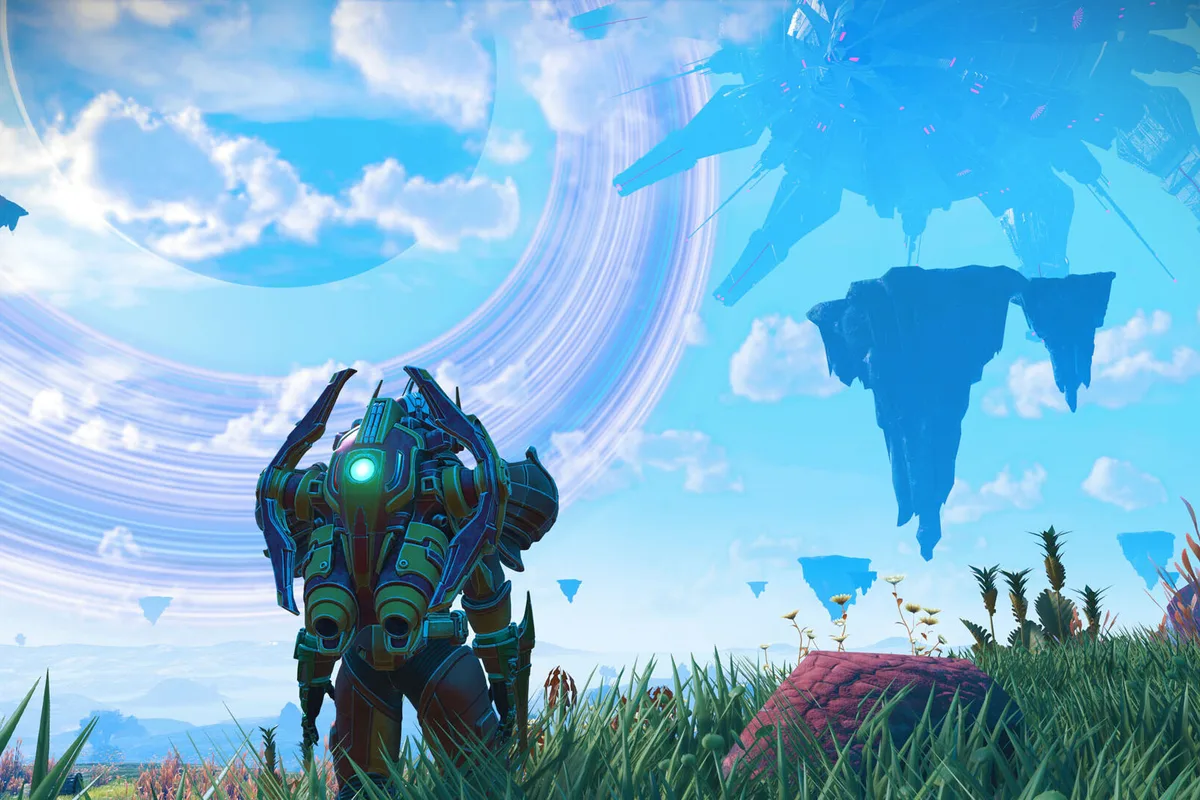
The 2026 updates keep turning old assets into new toys
Remnant is a perfect example.
The Gravitino Coil gives the Multi-Tool genuine physical manipulation, allowing debris to be grabbed, transported, thrown or recycled. The Colossus can be rebuilt into trucks, industrial haulers and much stranger vehicles.
The salvage loop can become repetitive, and criticism of the Remnant expedition correctly noted how quickly waste collection could start feeling like work.
The underlying idea remains compelling: Hello Games looks at objects already populating its universe and asks how they might suddenly become interactive.
Xeno Arena gives procedural wildlife another reason to matter
April's Xeno Arena applied the same philosophy to creatures.
Animals can now be trained, bred, genetically modified and entered into battles. Rare biomes and variants therefore feed a more structured collecting loop.
Players can construct arenas and invite others to compete.
It does not suddenly turn No Man's Sky into a deeply competitive monster battler, but an unusual creature is now potentially more than another catalogue entry.
The Swarm finally makes space warfare look enormous
The latest released major update remains The Swarm, version 6.4, followed by fixes through 6.45.1.
Its Hive of Glass is a vast hostile structure surrounded by clouds of drones and allied ships. Hello Games calls these the largest space battles it has built for No Man's Sky.
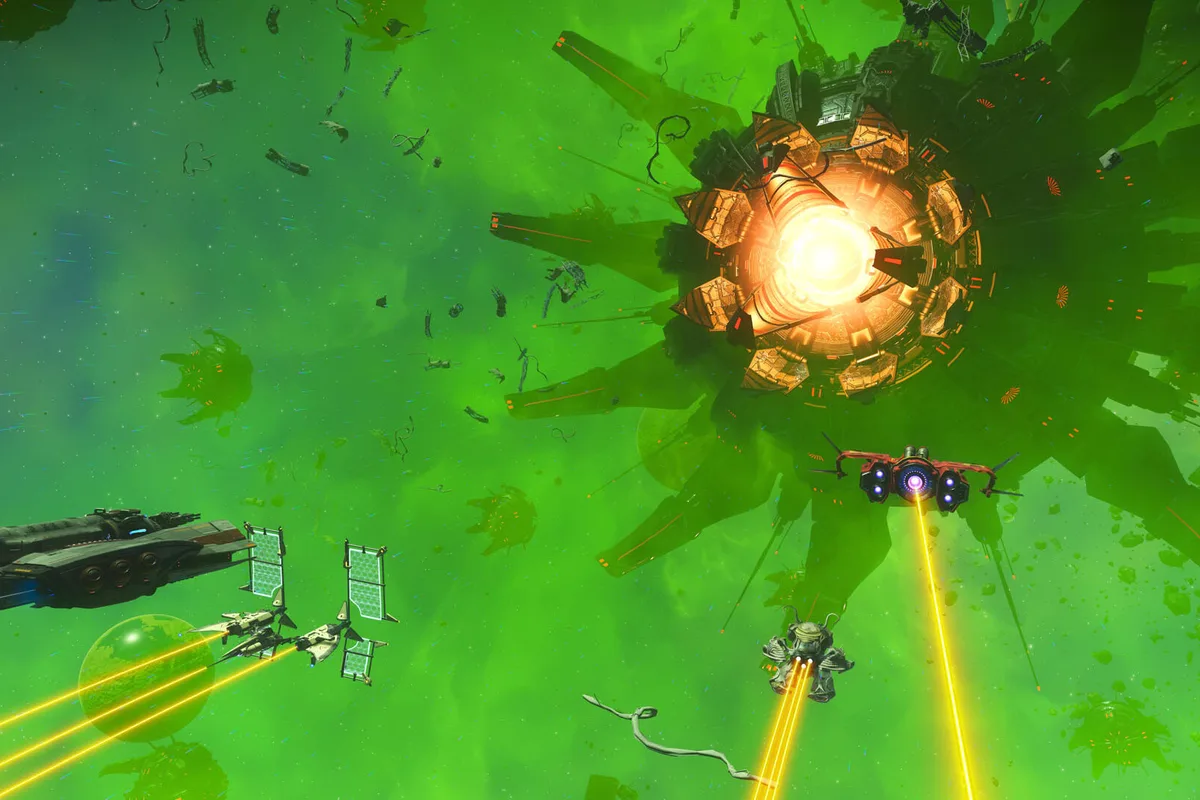
The scale works. Flying into a cloud of small fighters around a structure that dominates the sky gives space combat an intensity it previously lacked.
Mechanical depth does not expand quite as dramatically.
The expedition repeatedly sends players through related intervention tasks to feed the communal war effort, and the final encounter is more memorable for its image than for unusually complex boss design.
Expeditions remain the best re-entry point
Opening a years-old save can now be intimidating simply because No Man's Sky contains so many overlapping systems.
Expeditions solve that elegantly. They create a temporary fresh start with clearly staged milestones and gradually introduce the mechanics relevant to the current theme.
The Swarm turns the structure into a community event, splitting Travellers between three factions whose contributions feed a shared conflict.
It gives direction to a sandbox whose defining feature has always been the lack of required direction.
Infinite scale still cannot produce infinite novelty
No Man's Sky retains its oldest paradox. The universe is effectively endless; the procedural vocabulary used to create it cannot be.
After enough hours, families of terrain, structures, creatures and encounters become recognizable.
Worlds Part I and II enormously improved biomes, oceans, cloud rendering and planetary variety, delaying repetition without eliminating it.
The game works best when discovery is not defined exclusively as finding a completely new content category. Sometimes a particular combination of weather, light, geography and color is enough.
The real achievement is continuity
Hello Games' most impressive feat may not be the number of updates.
It is that they were attached to the same journeys.
Bases, fleets, discoveries and long-running saves survived while the game around them changed dramatically.
Returning after two years therefore feels less like installing a sequel than revisiting a familiar place that kept growing in your absence.
Cosmos has been named, not released
For the tenth anniversary, Hello Games revealed that its next major update is called Cosmos.
No feature list or release date has been provided, so Cosmos is not part of this review.
The current playable state remains the game as expanded through The Swarm and patch 6.45.1.
That is already enough to invert No Man's Sky's old reputation. In 2016 it was famous for what was missing. In 2026, its most convincing criticism may be that there is now so much here that players must decide what to ignore.
Strengths
- An absolutely enormous range of playstyles
- Exploration still produces genuine moments of discovery
- Voyagers fundamentally changes the relationship with ships
- Remnant and the Gravitino Coil add meaningful physical interaction
- Xeno Arena gives procedural creatures a new purpose
- The Swarm delivers the game's most spectacular space battles
- Nearly forty major free updates across ten years
Weaknesses
- System accumulation can be intimidating for newcomers
- Some loops remain repetitive once their novelty wears off
- The Swarm is more spectacular than genuinely deep
- Resource management and menus can still interrupt the flow
In its 2026 state, No Man's Sky has become an enormous science-fiction sandbox capable of supporting radically different playstyles. Voyagers turned the starship into living space, Remnant introduced a surprising physics playground, Xeno Arena gave creatures a new purpose and The Swarm pushes space combat toward a larger scale. That abundance has a cost: overlapping systems, dense interfaces, uneven activities and expeditions that can occasionally feel padded. Yet the core survives. Ten years later, exploration remains pleasurable, the game respects players' investment extraordinarily well, and every return feels as though another game has been grafted onto the one you left behind.