
News News Official
Is Ubisoft really in crisis? Studios are closing, but the games are finally offering a few reasons for optimism
Calling Ubisoft troubled has become almost too easy. Studios have closed, projects have been cancelled, releases delayed and costs cut. Then Assassin's Creed Black Flag Resynced arrived, beat its full-year sales expectations in two weeks and set a new Steam concurrency record for the franchise. The company is clearly under pressure. The games are beginning to tell a slightly less miserable story.
 By Maëlle Ubisoft
The crisis indicators are not imaginary
Ubisoft's portfolio review ultimately removed seven projects and delayed six others. The cancelled Prince of Persia: The Sands of Time remake became the most visible casualty, but the process went well beyond one difficult production.
The workforce fell to 16,590 employees by the end of March 2026, around 1,200 fewer than a year earlier. Since then, Ubisoft has announced the closure of its Winnipeg and Belgrade studios, restructuring in Barcelona and targeted changes to its global publishing organization.
This is a company becoming materially smaller.

Cutting games can be both a failure and the correct response
Seven cancelled projects are evidence that earlier planning did not work. There is no particularly elegant way around that.
Delaying six other games is more complicated. Ubisoft says it is giving projects more time in response to a selective market and higher quality standards. If that produces stronger releases instead of another round of expensive recoveries after launch, the delay itself is not necessarily the problem.
The next releases have to prove that distinction matters.
Black Flag Resynced delivered exactly the kind of result Ubisoft needed
By late July, Ubisoft said Assassin's Creed Black Flag Resynced had reached 3.5 million sell-in units after fourteen days, already exceeding the company's full-year expectations for the title.
It also peaked at roughly 105,000 concurrent players on Steam, which Ubisoft described as an Assassin's Creed record on the platform. Its 84 aggregate rating also made it the series' best-reviewed release since the original Black Flag.
One successful remake cannot repair an organization this large. It can demonstrate that a tighter release process is capable of producing something players actually want at launch rather than six months later.
The old games still matter almost as much as the new ones
Rainbow Six Siege remained in line with expectations during the first quarter and average daily active users edged higher despite a difficult comparison against the previous year's Siege X launch.
The Division 2 improved monetization, The Crew Motorfest continued to grow player activity around seasonal content, and mobile title Invincible: Guarding the Globe produced a record quarter more than two years after release.
A company in transition needs that boring durability.
Creative Houses are Ubisoft's attempt to change who owns the decision
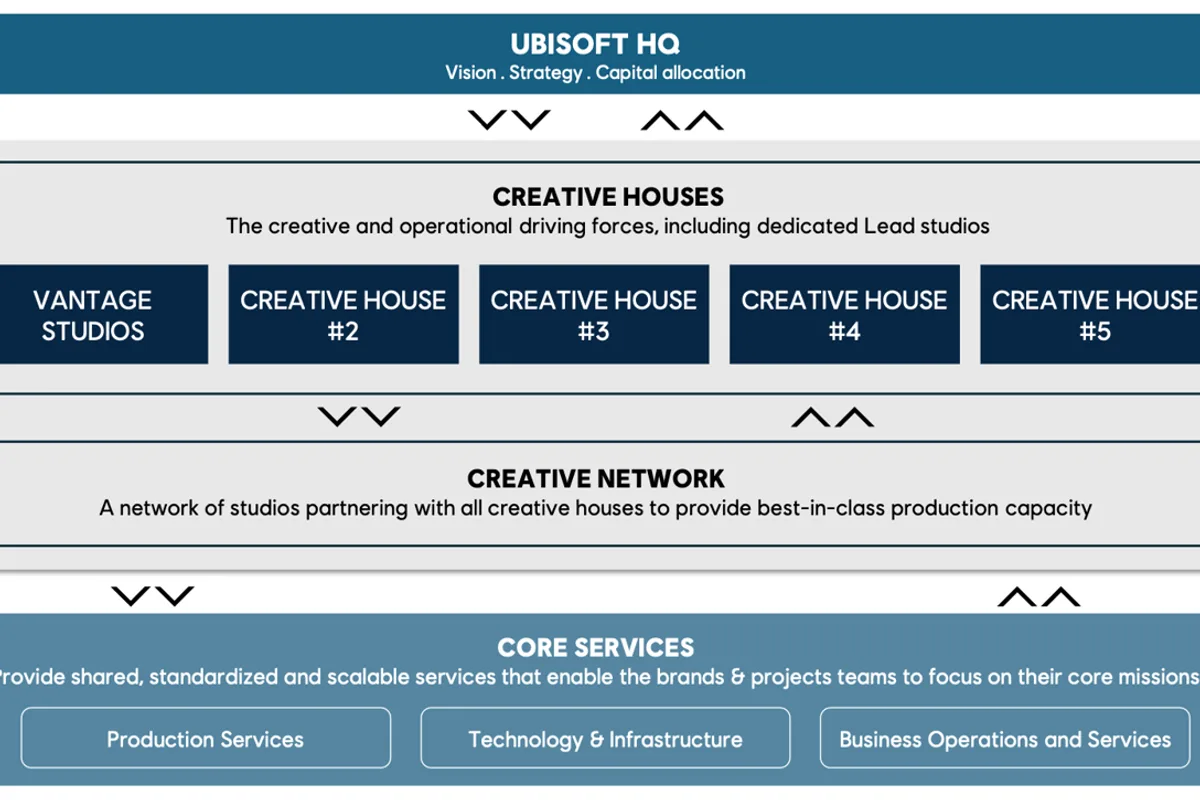
Ubisoft is now separating its major brands into five Creative Houses with their own leadership and clearer responsibility for budgets, roadmaps and performance. Vantage Studios controls Assassin's Creed, Far Cry and Rainbow Six, while other houses group battlefield games, live experiences, narrative adventures and casual or mobile projects.
A Creative Network sits behind them to provide development capacity and specialist support. Core services remain centralized for technology, infrastructure, production tools and business operations.
It is a fairly radical rewrite of how Ubisoft has organized decades of multi-studio development. Whether that creates accountability or merely reorganizes complexity will take more than one good July launch to answer.
The real recovery attempt begins after this transition year
The remaining 2026 calendar is comparatively restrained. Rayman Legends Retold is due on October 1 and Just Dance: Decades of Hits follows on October 13, alongside continued live-service updates and additional established-brand premium games that have not all been announced.
Ubisoft is pointing to 2027-28 and 2028-29 for a significantly stronger slate featuring major franchises including Assassin's Creed, Far Cry and Ghost Recon.
That future pipeline is the bet. Black Flag is evidence, not proof.
For players, the next few releases will tell the story faster than the balance sheet
Ubisoft is cutting projects, studios and costs because the previous model produced too many expensive problems at once. That qualifies as a serious corporate crisis even if it does not mean every game or studio is failing.
Recent releases have at least started moving in the right direction. The question is whether that pattern survives when Ubisoft has to deliver new major productions rather than remakes and back-catalogue support.
If the next Assassin's Creed, Far Cry and Ghost Recon arrive strong, 2026 may eventually look like the ugly restructuring year before a recovery. If they do not, there will be much less left to cut without touching the franchises meant to save the company.