
Review
Resident Evil Requiem: Grace is terrified, Leon breaks everything, and Capcom finally finds the balance

Resident Evil Requiem deliberately separates its two identities. Grace turns every bullet into a decision and every corridor into a threat; Leon then arrives with an axe, heavy weapons and enough confidence to completely change the game's temperature. The join is sometimes visible, but rarely this effective.
Resident Evil Requiem solves the franchise's long-running horror-versus-action problem by refusing to make every scene do both jobs.
Grace Ashcroft gets the anxiety. Leon S. Kennedy gets the catharsis.
Grace makes ammunition frightening again
GameSpot and PC Gamer both praise her resource-starved exploration. The care facility becomes a puzzle box where knowing routes, enemy behaviour and locked spaces matters as much as accuracy.
Zombies retain fragments of old routines, reacting to sound, light and familiar tasks. That gives stealth something more interesting than simple vision cones.
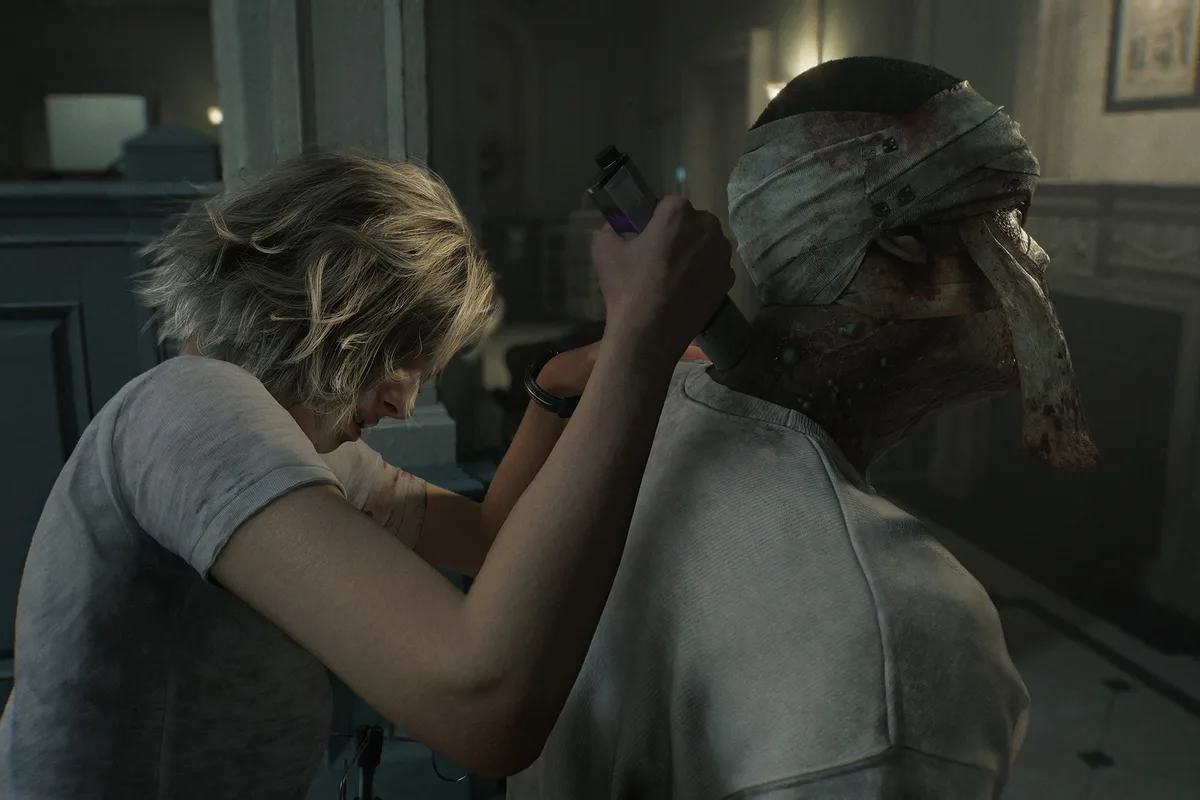
Crafting turns gore into arithmetic
Grace can collect infected blood and convert it into ammunition, survival resources and powerful hemolytic injectors.
The system works because materials compete with one another. Solving one problem immediately can make another corridor more dangerous later.
Leon is designed as release
PC Gamer's review captures the tonal shift well: Leon enters spaces with rifles, a revolver, melee finishers and an axe where Grace previously survived by restraint.
His parry is responsive and readable, while weapon upgrades make the action feel deliberate rather than disposable.
The two halves eventually bleed together
Grace becomes more capable as the story progresses, and Leon eventually faces encounters able to challenge his enormous confidence.
That prevents Requiem from becoming two entirely independent campaigns, although GameSpot still finds the structure inelegant at times.
The final stretch leans too hard toward spectacle
TechRadar argues that the carefully maintained horror-action balance deteriorates later, with the action side increasingly dominant. The Guardian similarly finds some late boss fights less memorable than the set pieces and exploration that precede them.
That criticism is persuasive because Requiem's strongest sequences usually involve uncertainty, space and resource pressure rather than pure scale.
A disciplined campaign
PC Gamer praises a roughly ten-hour critical-path experience with little obvious padding. Capcom's worldwide telemetry now records an average first completion time of 19 hours and 14 minutes when restarts, cutscenes and pauses are included.
The exact number matters less than the structure: this is still a tightly authored campaign rather than an open-world checklist.
Two Resident Evils in productive conflict
Requiem never fully fuses Resident Evil 7's vulnerability with Resident Evil 4's power fantasy. It does something more practical.
It lets one make the other feel stronger.
Strengths
- Excellent contrast between Grace and Leon
- Strong resource management with Grace
- Dense, readable level design
- Interesting infected-blood crafting system
- Leon's combat is highly responsive
- Focused campaign with little obvious filler
Weaknesses
- The join between horror and action can feel visible
- Second half leans more heavily into action
- Some late boss fights are underwhelming
- Enemy variety is narrower than expected
Resident Evil Requiem achieves less of a perfect fusion than an excellent system of contrast. Grace makes every bullet threatening; Leon turns the same world into spectacle. Moving between them creates an unusual and often brilliant rhythm, even if the later game occasionally forgets how effective its fear had been. Capcom now understands both languages well enough for their differences to become a strength.