
Review
The Crust 1.0: The Moon Gets Interesting When the Logistics Start Breaking

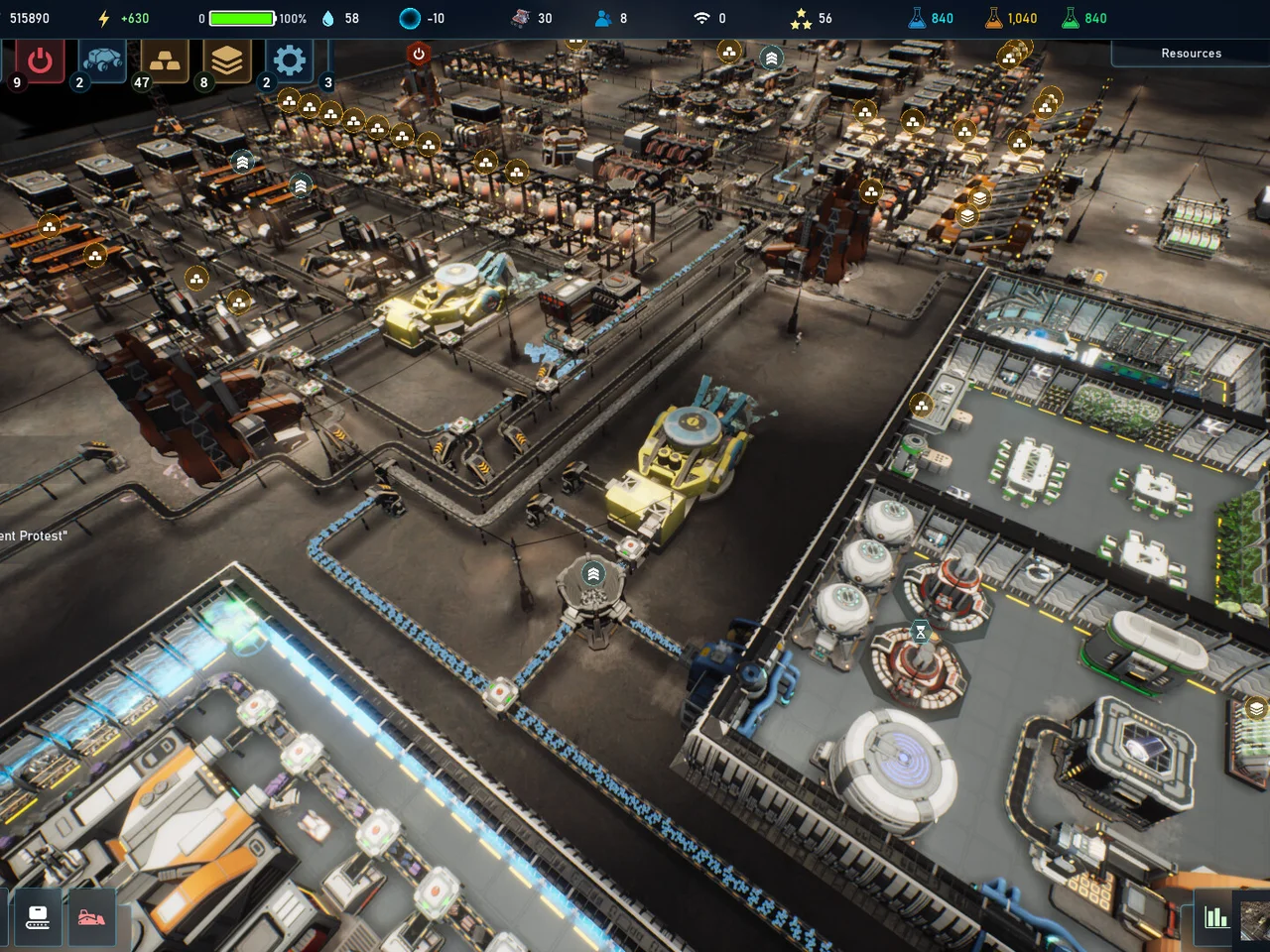
The Crust is at its best when dealing with flows: mining impure regolith, separating materials, feeding production lines and shipping goods back to Earth before a deadline. Version 1.0 makes large factories much easier to design thanks to Planning Mode, but lingering manual chores and a rough opening keep its excellent industrial puzzle from matching the genre's sharpest systems.
The ore itself creates the first real problem
The Crust initially speaks the familiar language of factory games: extractors, conveyors, processors, assemblers and storage. Its strongest mechanical idea appears when the material entering that system refuses to behave like a neat resource token. Regolith contains varying proportions of iron, aluminium, silicon, titanium and slag.
PC Gamer identified this as the standout idea during Early Access. A production line that works with titanium-rich material can behave very differently when the next incoming batch contains only a small percentage of titanium. Suddenly the question is not how many machines can fit on the Moon, but which part of the flow will starve first and which one will jam.
Contracts turn throughput into an economy
Version 1.0 gives those industrial calculations a clearer external purpose. Earth contracts place deadlines and financial value on production. Material sitting in storage is potential expansion, potential profit and potentially a missed delivery at the same time.
Respawn.pl praised exactly that tension, while Game Atlas highlighted the Earth market as one of the game's strongest distinguishing systems. It prevents expansion from becoming an exercise in increasing numbers merely because larger numbers exist.
Planning Mode changes how large bases feel
The most practical 1.0 addition is also one of the least glamorous. Planning Mode allows modules and conveyors to be laid out before spending the resources, with copying and recipe information carried into the plan. Large projects become designs rather than expensive experiments.
Roads, improved conveyor controls and additional trade automation push in the same direction. VEOM Studio has spent Early Access adapting its tools to the scale that its own simulation encourages.
That matters once a factory is large enough that changing one production branch can disrupt several others. Better planning does not remove the puzzle. It lets the player reach the interesting part of it sooner.
Colonists keep the factory from becoming sterile
The Crust also refuses to let machines solve everything. Colonists bring health, morale, skills and staffing into the calculation. Social infrastructure consumes space and resources, but treating the workforce as an afterthought carries its own cost.
InsertCoins considers this crew-management layer one of the game's clearest departures from pure automation. It gives production consequences beyond throughput because the base has to function as a place where people survive, not just as a diagram.
The automation still has irritating manual edges
There is an awkward contradiction here. A game about building systems that take work away from the player still contains chores that critics and returning players argue should become automated sooner. The larger the colony becomes, the more visible those exceptions are.
The opening is another weak point. Several current reviews describe a steep early learning curve, and the game's industrial depth is broad rather than infinitely granular. Players seeking the extreme combinatorial freedom of the most specialised factory games may find its production layer comparatively conventional once individual recipes are understood.
The trade-off is that The Crust keeps adding other variables to the equation. The best moments are not about a perfectly running conveyor belt. They begin when that belt stops being the only problem.
Strengths
- Regolith processing creates genuine flow problems rather than a simple ore-to-product chain
- Contracts give production a concrete economic purpose
- Planning Mode greatly improves large-scale factory design
- Colonists, power, expeditions and trade push the player beyond conveyor optimisation
- Campaign and Sandbox 2.0 support two legitimate approaches to building
Weaknesses
- The opening remains steep and sometimes poorly explained
- Some operations stay too manual for a game built around automation
- Pure production-chain depth remains below the most specialised genre leaders
- Pacing can drag before the larger systems begin to interlock
The Crust does not beat Factorio at pure automation depth, and it ultimately does not need to. Its mix of production, contracts, colonists and lunar constraints gives every factory line a tangible purpose. Version 1.0 turns what was once a promising foundation into a substantial industrial management game, even if parts of its interface and repetitive workload still lag behind its ambitions.