
News News Official
Steam Machine: bad console or great living-room PC? The answer changes with the question
The Steam Machine keeps inviting the wrong comparison. It sits under a television, boots into a controller interface and looks every bit like a game console. Then Valve gives you a Linux desktop, replaceable storage, standard PC peripherals and the freedom to install another operating system. As a console, its price and graphics performance are awkward. As a purpose-built couch PC, it is a stranger and more convincing device.
 By Kader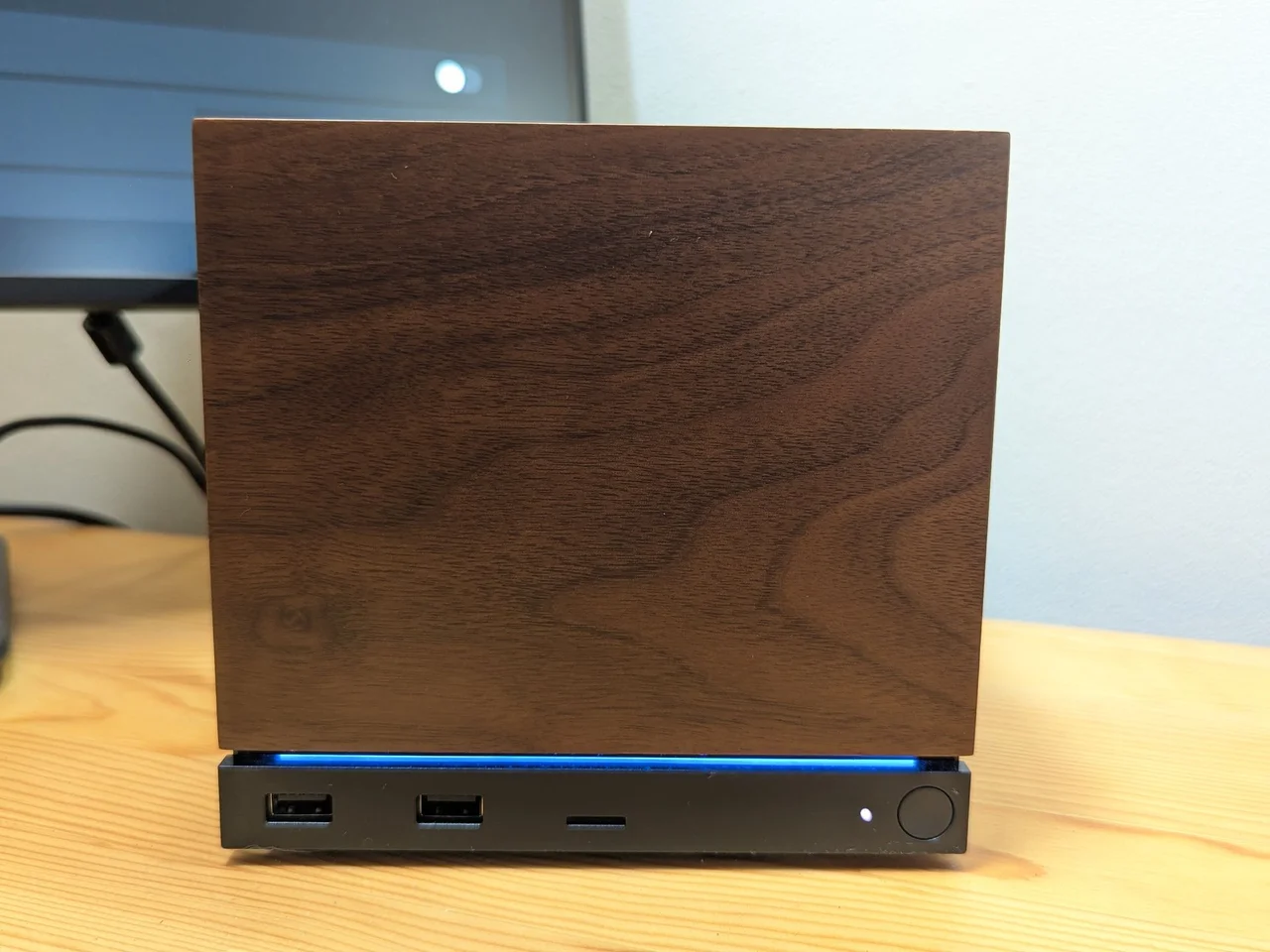
At $1,049 for 512 GB and $1,349 for 2 TB, this is not subsidized console hardware. Inside is a semi-custom six-core Zen 4 processor, 16 GB of DDR5 and a 28-CU RDNA 3 GPU with 8 GB of dedicated GDDR6 memory.
Independent benchmarks put that GPU in decidedly modest desktop territory. GamersNexus found results broadly comparable to cards including the RX 6600, RTX 3060 and Arc B570 depending on the workload. PC Gamer also found conventional gaming PCs around the same price capable of significantly higher frame rates.
If the comparison ends there, the Steam Machine loses.
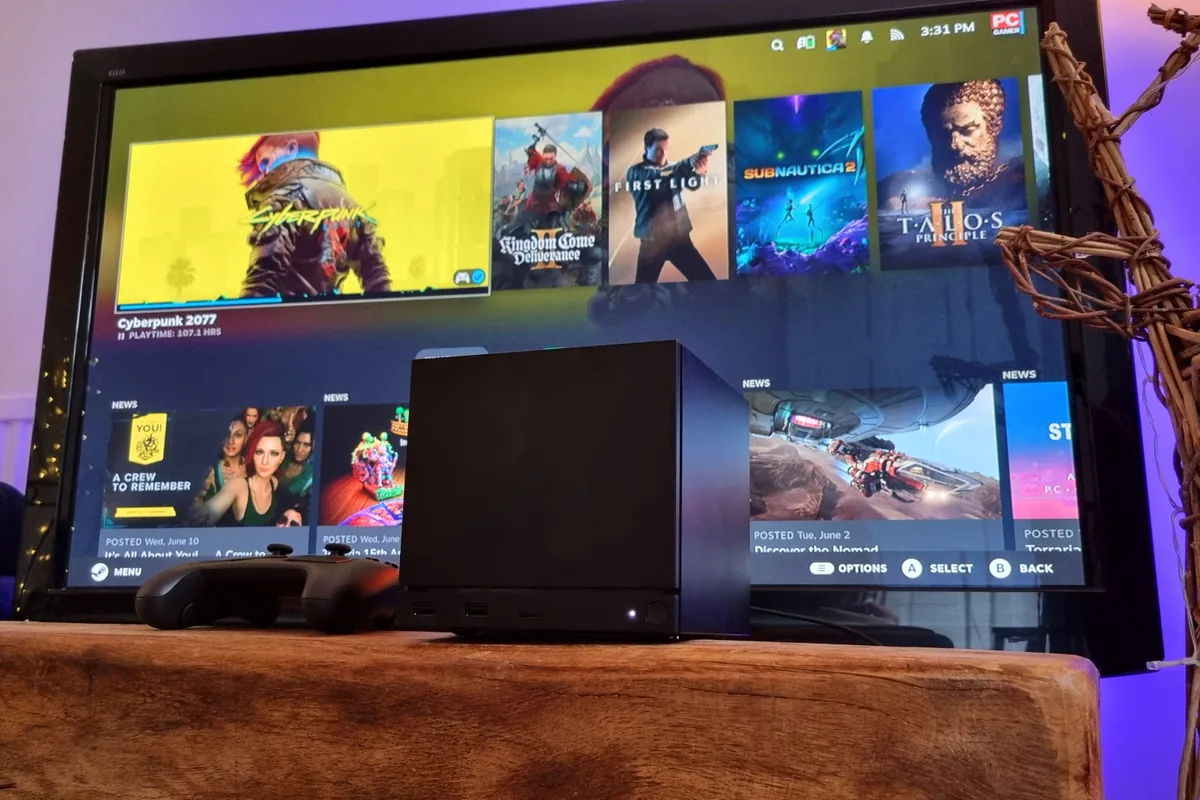
Its television may be 4K, but the GPU often prefers 1080p
Valve built the Machine for modern TVs and promotes high-resolution output, yet demanding games frequently rely on upscaling and frame generation rather than native 4K rendering. Reviews consistently found 1080p to be its comfortable territory, with 1440p viable in many games and 4K becoming increasingly dependent on compromises.
SteamOS itself can default games to 1080p to prioritize smooth play. That is a sensible engineering choice for 28 RDNA 3 compute units. It is also a slightly odd first impression from a four-figure box connected to a 4K television.
Software has improved since launch. FSR 4.1 support on the RDNA 3 hardware has started changing the experience in compatible games, with recent testing reporting cleaner reconstruction and better frame-generation behavior than the launch software offered.
Software can stretch this hardware surprisingly far. It cannot turn it into a high-end GPU.
The hardware design solves problems benchmarks do not measure
Valve's cube is roughly 16 cm on each side, carries its power supply internally and cools the system with a large 120 mm fan. Multiple reviewers have highlighted how quiet it remains under load.
That matters in a living room. A cheaper tower with a faster graphics card wins a benchmark comparison, but size, acoustics, cabling and controller-first operation are part of this product too.
The result feels less like Valve tried to build the fastest $1,000 PC and more like it tried to compress the least annoying gaming PC into the smallest box it could reasonably cool.
Desktop mode is where the console comparison falls apart
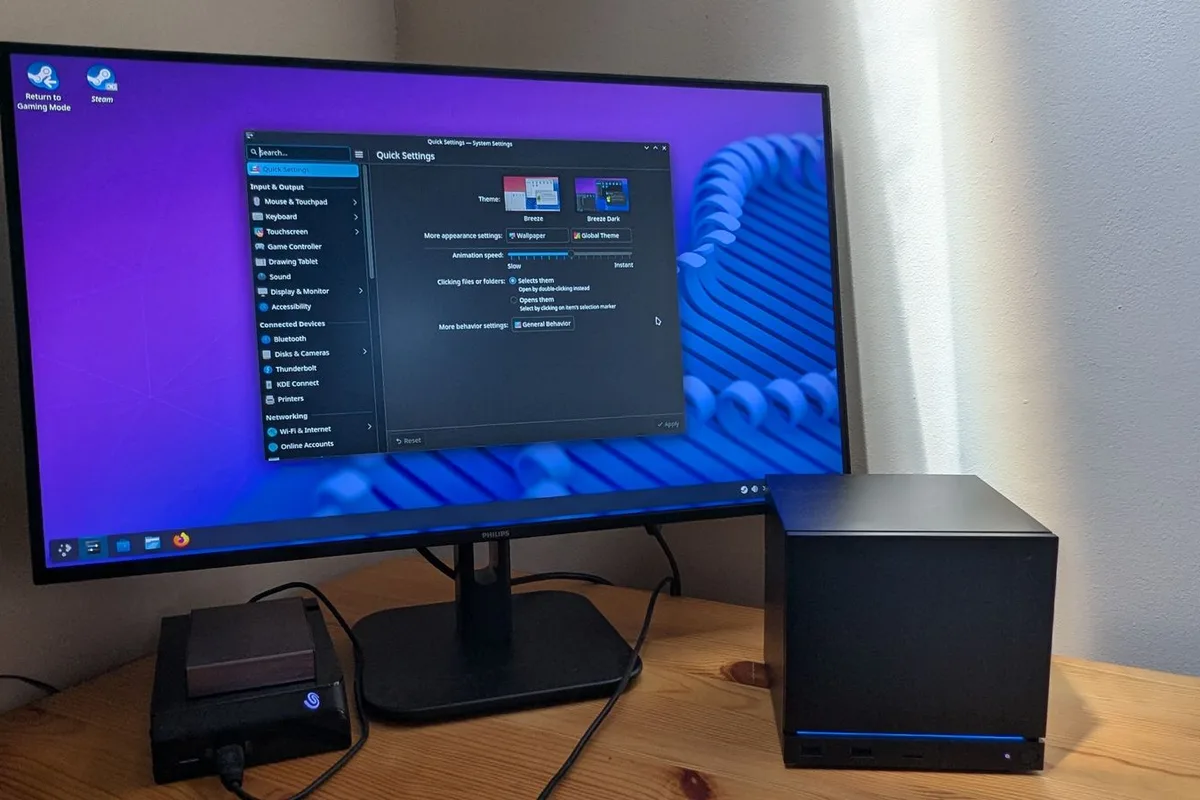
Switch out of Gaming Mode and the Steam Machine exposes KDE Plasma. It becomes an ordinary Linux desktop with a file manager, software installation, browsers, keyboard and mouse support and the usual freedom to treat the machine like a computer.
Its NVMe storage is accessible, microSD expansion is built in and Valve has even released Windows drivers. None of that makes games faster. It does mean the box does not become obsolete the moment Valve stops treating it like a console.
That openness is also the reason it can occasionally be less convenient. Third-party launchers, Linux compatibility and anti-cheat support can introduce friction that a closed console platform largely avoids.
SteamOS is the product Valve could not build in 2015
The original Steam Machine idea arrived before Proton, before the Steam Deck and before Valve had years of real-world data on making Windows games behave predictably on Linux.
The 2026 hardware benefits from all of that work. Gaming Mode feels coherent on a television, existing Steam libraries carry over immediately and cloud saves make moving between a desktop PC, Steam Deck and Steam Machine unusually painless.
That ecosystem integration is harder to put in a benchmark chart than GPU throughput, but it is probably the strongest reason this machine exists.
The Steam Machine is better at being a PC that behaves like a console
As a traditional console proposition, the math remains rough. A controller costs extra, demanding AAA games can require substantial tuning and the 8 GB framebuffer is not generous for hardware expected to live beside a 4K display.
As a living-room PC, the same specifications become easier to understand. It is compact, quiet, open, upgradeable in the places that matter most, straightforward to operate with a controller and capable of doing considerably more than launching games.
That distinction does not magically fix the price. It does explain why calling the Steam Machine a disappointing console and an unusually good couch PC are not contradictory statements.