
News News Official
No Man's Sky 7.01 explained: the latest patch is mostly repairing Cosmos' enormous new systems
The latest No Man's Sky patch is far less spectacular than Cosmos, and that is exactly its job. After letting players own space stations, build bases in empty space, leave ordinary starships in deep space and physically tear giant wrecks apart until they explode, Hello Games inevitably created several new ways to fall through something that should have had a floor. Version 7.01 starts closing those holes.
 By Hugat No Man's Sky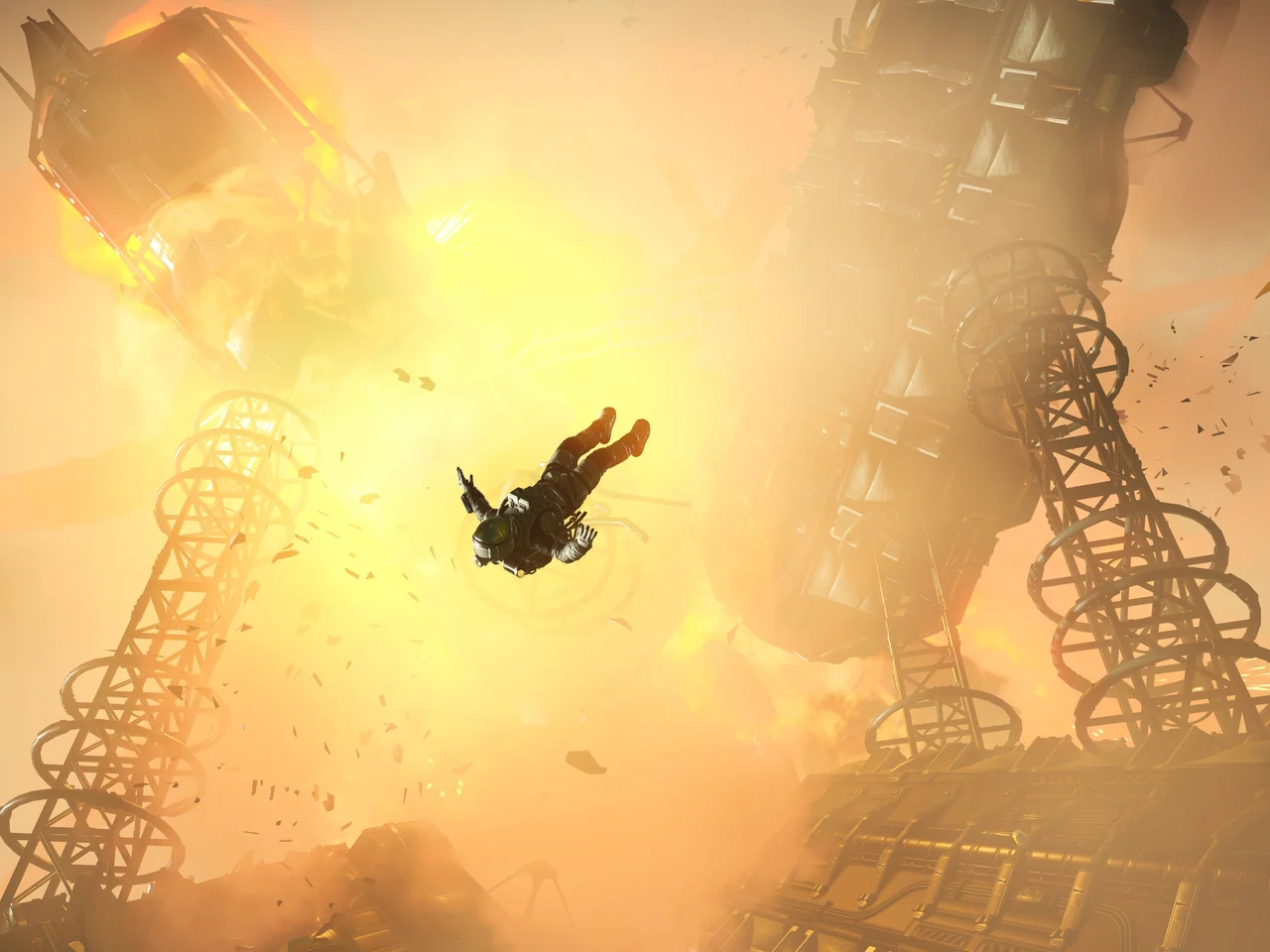
As of September 14, 2026, version 7.01 is the latest No Man's Sky patch published by Hello Games.
It arrived on September 10, only one day after Cosmos 7.0.
The distinction between those releases matters.
Cosmos 7.0 is the enormous tenth-anniversary content update. Version 7.01 is its first corrective patch.
There are very few genuinely new gameplay systems hiding inside 7.01. Its value comes from how many fixes directly target the systems Cosmos introduced.
Cosmos effectively rebuilds the space half of No Man's Sky
For years, space was primarily something players crossed while moving between planets, stations, freighters and occasional random encounters.
Cosmos tries to turn that transit layer into an exploration space of its own.
The clearest expression is the Star System Map.
Accessible from the Quick Menu, it displays local planets, the system's station and newly discovered deep-space points of interest.
A destination can be marked directly from the map and used for starship navigation.
That sounds obvious for a space game.
For No Man's Sky it fundamentally changes how a solar system is read: empty space finally has a geography.
Points of interest are becoming places rather than interruptions
Cosmos populates systems with rocky and icy asteroid belts, outposts, natural orbital platforms, debris fields, wrecks and other anomalies.
Many occupy fixed, revisitable locations.
That matters because a large amount of older space content behaved like procedural events appearing during travel.
A location that remains on a map becomes somewhere players can intentionally return to.
Version 7.01 reinforces that idea.
Appropriate completed objects can now remain visible on the system map, the current galaxy is displayed and several information popups have been cleaned up.
Huge derelict hulks are probably the best demonstration of Cosmos' new space design
Space Hulks are enormous abandoned wrecks drifting through deep space.
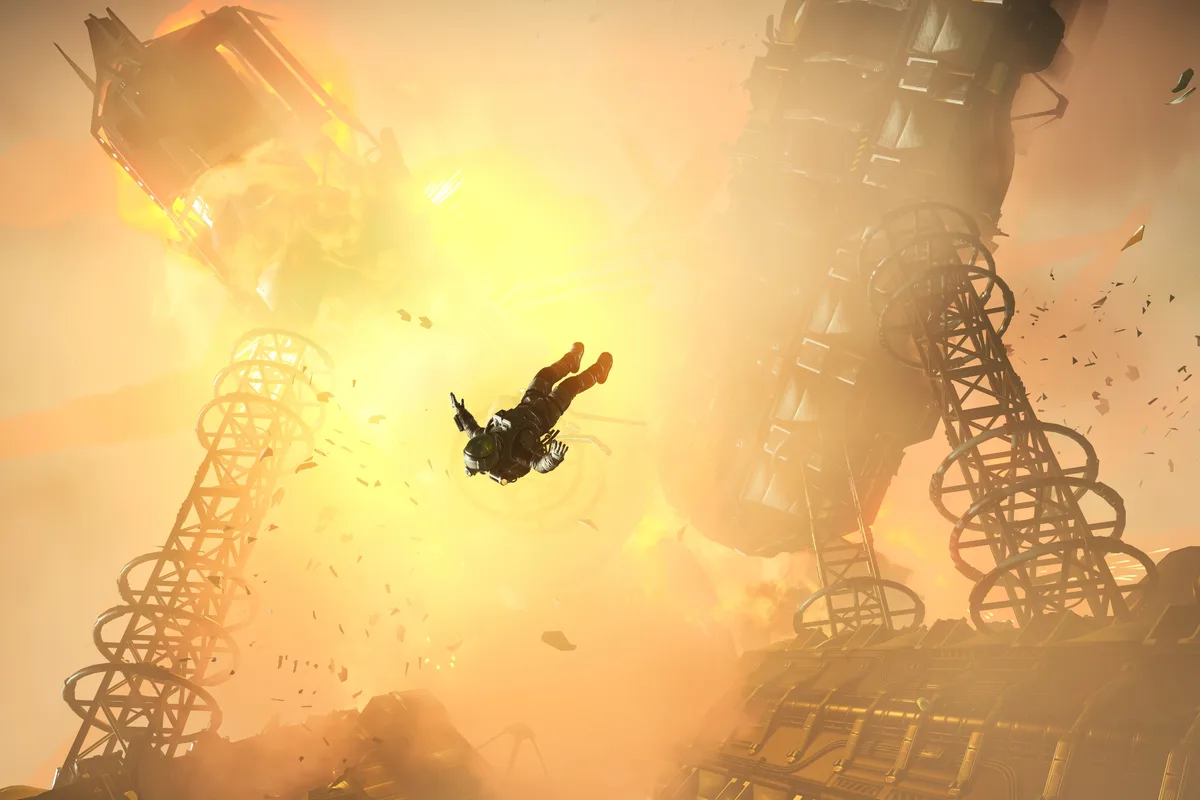
Players can approach them, leave their ship and explore their exterior or confined interiors through EVA.
The Gravitino Coil can physically pull valuable components from the wreck.
A Corvette equipped with the new Tractor Beam can collect that salvage into its cargo system.
The activity almost becomes a small orbital demolition game.
Except that hulks have structural integrity.
Remove too much and a meltdown can begin.
The sensible strategy is to scan the wreck, identify the most valuable pieces and take those first before the entire structure decides to become a temporary sun.
7.01 makes that salvage loop considerably less awkward
Meltdown messaging has been improved.
Important hulk pieces now receive additional visual effects.
Several physics problems affecting salvageable props have been fixed.
The Tractor Beam's Vent Cargo button could stop functioning; it now works correctly.
Most importantly for multiplayer, players completing a hulk or infested outpost together can both claim the relevant rare rewards.
That looks like a tiny patch-note bullet.
For a cooperative activity, it prevents a shared expedition from turning into a race to see who touches the valuable object first.
The Tractor Beam is less a weapon than Cosmos' garbage truck
The new Tractor Beam is a Corvette utility module.
It collects physical salvage and minerals extracted from deep-space locations.
Oversized objects can be processed for easier storage.
That is important because Cosmos does not always convert salvage instantly into an inventory icon.
Some valuable material exists as a physical object that has to be moved, collected and transported.
The Gravitino Coil manipulates it. The Tractor Beam captures it. The Corvette carries it. Deep-space outposts process or buy it.
Cosmos is effectively building a logistics loop around shipbreaking.
Deep-space outposts are the service stations supporting that economy
Deep-Space Outposts are inhabited structures positioned away from planets.
A quartermaster sells maps and trades salvage materials.
A dedicated terminal offers recovery and delivery contracts.
Version 7.01 adds a Galactic Trade Terminal directly to the Quartermaster's room.
It is a small but sensible improvement.
If Cosmos encourages players to return from a wreck with a Corvette full of exotic metal, forcing them to leave again just to access the galactic market would interrupt the entire loop.
The patch also improves interior decoration variety and fixes several collision and NPC placement issues.
Some outposts are much less friendly
Cosmos also introduces Infested Outposts.
Biological growth blocks their corridors and has to be cleared with the Gravitino Coil.
Pathogen Sacs, Gelatinous Fibres and other unpleasant resources can then be extracted.
Version 7.01 fixes an icon swap between Pathogen Sacs and Viral Hearts.
That is not transformative.
It is representative of what this first patch does: clean up the enormous quantity of new interactions and items that arrived only a day earlier.
A large portion of 7.01 is devoted to stations players can now own
The wildest Cosmos feature may still be Space Station Directorship.
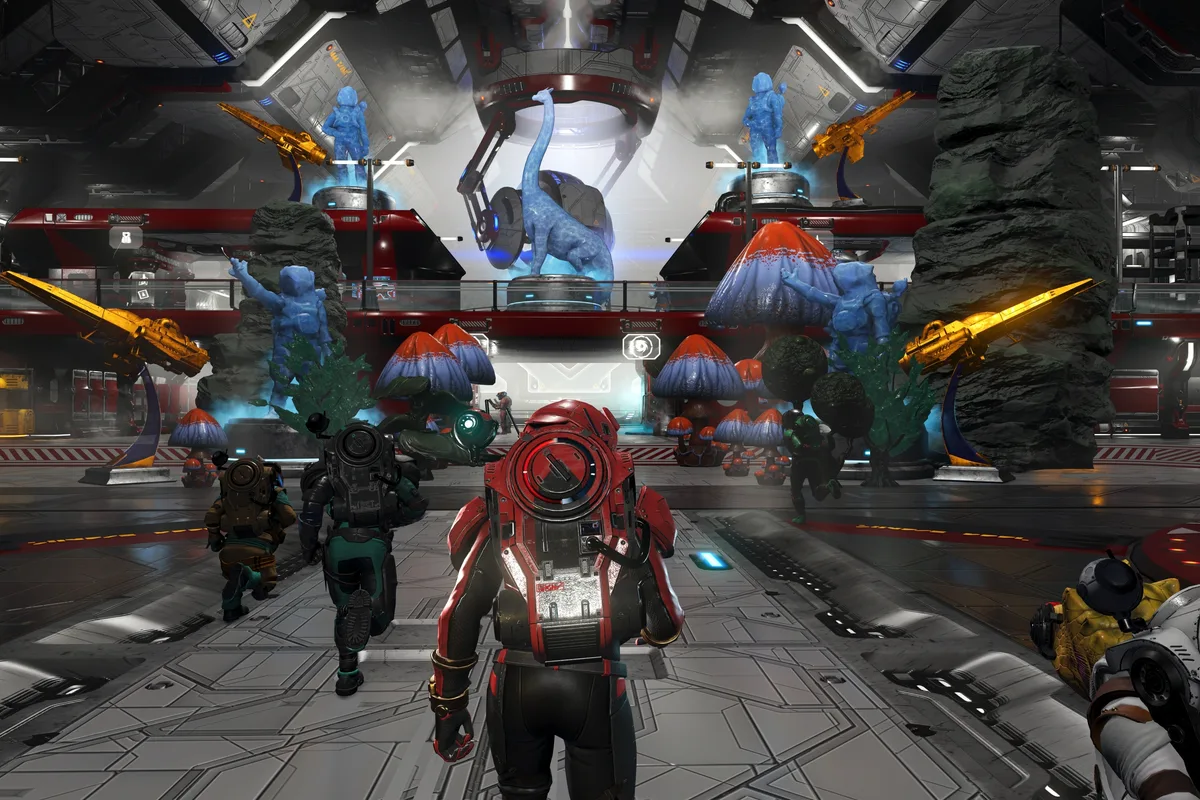
After proving themselves to local authorities, players can claim directorship over a station and begin reshaping it.
The central interior can be decorated with familiar base-building pieces.
Additional rooms can be attached to the main hangar.
Huge decorative modules can also be placed around the exterior.
A procedural station that used to belong entirely to the game effectively becomes a gigantic personal base.
7.01 fixes some fairly dramatic side effects of that freedom
Several geometry problems affecting new station pieces have been corrected.
Decorations could disappear in Korvax-controlled stations.
Some purchased exterior parts failed to unlock.
The platform surrounding the station core contained geometry problems.
Stairs could use incorrect colors.
And one bug could simply make players fall out of the station.
For an update about owning your own orbital property, preventing the director from falling through the lobby into space seems like a reasonable first hotfix priority.
The way some station decorations unlock has changed as well
Certain station pieces are now unlocked through salvaged materials.
That creates a more direct connection between deep-space recovery and station customization.
Shipbreaking is not only another route toward Units.
Part of what players recover can feed back into the system that visibly represents their progress through station construction.
That is far more coherent than keeping salvage and customization in completely separate economies.
Stations are also becoming social headquarters
Station directors can found Alliances.
Other Travellers join by visiting an Alliance-owned station.
A player can belong to as many as three Alliances.
They are graded according to member activity, with large and active groups appearing on station leaderboards.
Teleporters provide quick travel toward systems controlled by the Alliance.
No Man's Sky is therefore gaining something resembling a persistent layer of galactic society rather than only temporary multiplayer groups.
It is nowhere near a political MMO simulation, but the idea of a network of player-owned stations defining communal territory is considerably more ambitious than ordinary co-op.
7.01 is already cleaning up the first Alliance problems
Alliance names now display correctly in the teleporter UI.
They also appear on the Star System Map.
Long names no longer overflow some title notifications.
Several unclear interface states caused by multiple players attempting to claim the same station have been corrected.
None of these changes is glamorous.
For a social system built around ownership and named communities, reliably displaying who owns what is still a fairly essential foundation.
Players can now build a base in empty space
Cosmos introduces Orbital Constructions.
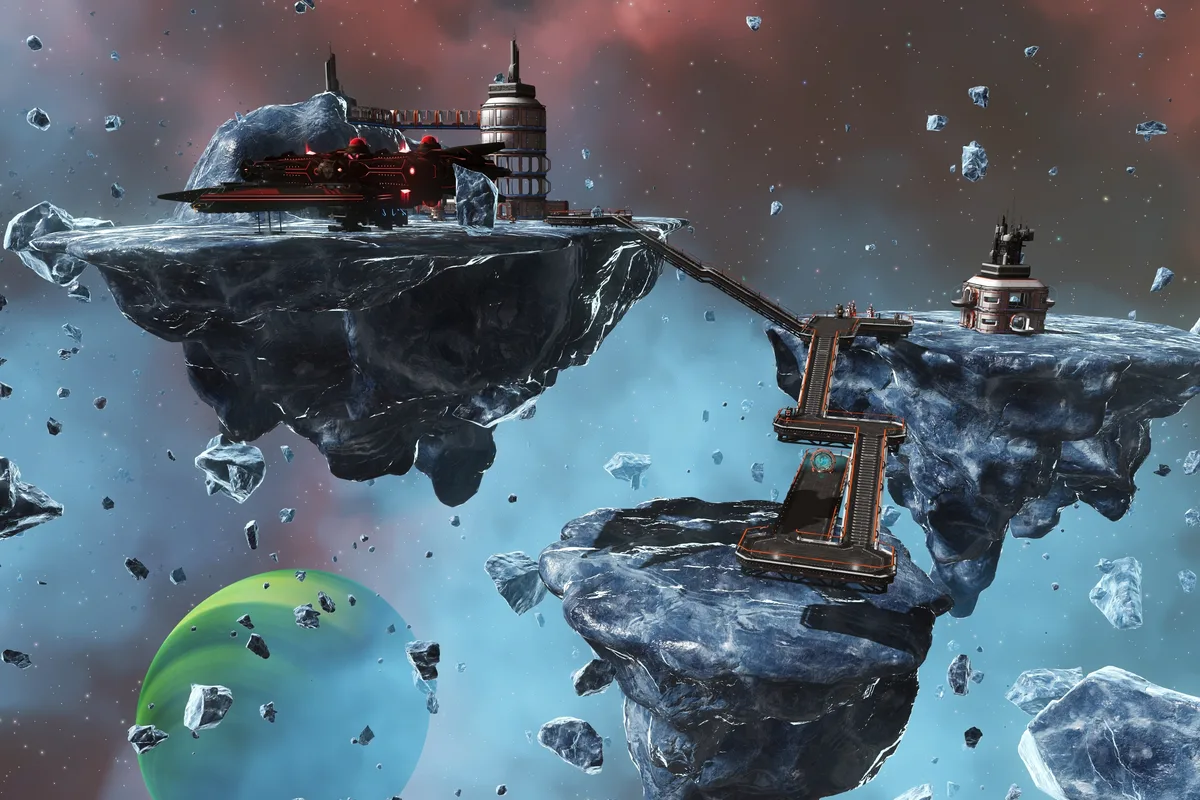
A Deep-Space Base Computer can claim a volume of open space.
Players can then use familiar construction systems to create an orbital habitat without needing a planet underneath it.
Natural asteroid platforms can also act as foundations.
The system supports the obvious practical fantasies — truck stops, military installations and observation platforms — alongside the inevitable completely unnecessary megastructure built in front of a planet simply because nobody has stopped the builder.
That is extremely No Man's Sky.
Spacewalking is now a proper system rather than a novelty
Voyagers had already made EVA more important around Corvettes.
Cosmos extends it to ordinary starships.
Any pilot can use the Quick Menu to leave their ship while in space.
Movement supports true six degrees of freedom, including roll.
Players can orient themselves freely rather than moving as if an invisible floor still existed.
Cold protection drains during EVA unless another nearby hazard changes the environmental conditions.
Explosions can physically knock the player backward.
7.01 contains a surprising number of camera fixes because of that freedom
Hello Games fixed several camera problems when entering and leaving EVA.
Photo Mode had issues while spacewalking.
Large objects such as freighters and frigates could cause additional camera problems.
The armed third-person camera has been adjusted to more closely match ordinary EVA movement.
Several first-person spacewalking problems were corrected too.
That technical work matters more than it sounds.
Six-degree-of-freedom movement becomes miserable very quickly if the camera loses a consistent frame of reference.
Corvettes continue receiving another layer of fixes
Cosmos already included several corrections for Corvette-class ships inherited from Voyagers.
Version 7.01 continues the work.
Players could fail to enter another person's Corvette in multiplayer.
A Corvette parked at a deep-space outpost could begin flying again after a save reload.
Several visual problems affecting Corvette weapons have also been corrected.
Large walkable multiplayer ships remain an obvious technical challenge for Hello Games.
That is not surprising: a vehicle in which multiple players can walk while the entire structure moves through space is dramatically more complicated than a cockpit wrapped around a conventional ship model.
The Grave of the Ocean King apparently misplaced a few zeroes
One correction deserves special attention purely because of how ridiculous it is.
The Grave of the Ocean King could appear roughly 600 times smaller than intended.
Version 7.01 restores its proper scale.
No Man's Sky contains enough colossal objects that accidentally turning one into a miniature almost feels like a believable procedural event.
The new system map receives several genuinely useful improvements
The Star System Map now displays the current galaxy.
Its informational popups have been rearranged.
Marking a planet now uses the same icon as marking it from the Discoveries page.
Missing system-discovery messages have been fixed.
Lingering salvage mission markers now disappear correctly.
Individually, these are tiny adjustments.
Together, they make the map behave more like the central navigational tool Cosmos clearly intends it to become.
Stars themselves are finally physical destinations
One of Cosmos' most absurdly logical additions is also easy to explain.
The stars at the center of systems can now be reached through long-haul flight.
And no, approaching an enormous sphere of plasma is not particularly healthy.
Version 7.01 fixes several audio issues associated with stars.
It also closes a bug that allowed Creative Mode players to fly directly inside a sun.
Cosmos therefore still supports an impressive number of bad decisions.
Just not that one anymore.
The patch also stops parts of space becoming absurdly crowded
Too many pirates and traders could spawn around asteroid fields.
Version 7.01 reduces those excessive encounters.
That fits the goal of Cosmos surprisingly well.
Hello Games wants empty space to feel more alive, but an asteroid belt packed with ships like a shopping-center parking lot is not quite the same thing as believable activity.
A collection of more traditional No Man's Sky bugs disappears too
Not every 7.01 fix belongs to Cosmos.
The patch addresses gravity problems on derelict freighters, collision at the Nexus and an issue that could make players fall out of their freighter.
Scrolling the Quick Menu could accidentally eject players from an Exocraft.
A gray cube could appear around frigates.
Planetary rings could render through the interior of a station.
These are the usual small oddities of a game carrying ten years of interconnected systems inside the same universe.
7.01 is also a stability patch
Hello Games lists several crash fixes.
They involve audio management, Xeno Arena battles, inventory rendering and downloading base images.
A hang affecting PlayStation 5 users running the PlayStation 4 build has also been fixed.
Those changes sit on top of the much broader optimization work already included in Cosmos 7.0.
Because 7.0 changed an enormous amount under the hood too
Cosmos is not only a content expansion.
Hello Games rewrote the BC encoder used for runtime procedural textures to reduce color banding and compression artifacts.
Terrain tessellation quality has been improved.
Clouds viewed from space have higher-quality textures and lighting.
Asteroid generation has been overhauled for better distribution, draw distance and performance.
Water, fog, particles and HDR output also received substantial work.
The engine now supports Intel XeSS 3 and NVIDIA DLSS 4.5 with 5x and 6x Frame Generation on compatible hardware.
PC VR also gains foveated rendering support.
Optimizations hit almost every modern No Man's Sky pressure point
Hello Games added bindless textures, samplers and buffers on Xbox to significantly reduce CPU rendering overhead.
Inventories, multiplayer, Settlements, HUD markers, bases, animation and procedural generation all received optimization passes.
File-handling improvements are intended to reduce console loading times by 6 to 9 percent.
Asynchronous base updates should reduce frame-time hitches in complex constructions.
Mesh data has been reduced by roughly 13 percent.
That work is much less visible than an ownable station.
After ten years, however, continuing to add systems without repeatedly reducing their CPU, GPU and memory costs would eventually turn the game into a technical disaster.
Cosmos also contains the most self-referential anniversary expedition possible
Our Journey Continues is Expedition 23.
It travels through the ten-year history of No Man's Sky and its major updates.
Each milestone represents a point in that development history and unlocks developer commentary read by Sean Murray.
Those notes remain permanently accessible through Collected Knowledge once unlocked.
The rewards deliberately lean into nostalgia: a golden Rasamama S36, an early-style Sentinel Interceptor, Starbound v0.27 Multi-Tool, a diplodocus companion inspired by pre-release footage, commemorative artwork and an astronaut cockpit figurine.
Ten years after launch, Hello Games has effectively converted its own patch history into playable content.
So what does 7.01 actually change?
Not the core design of Cosmos.
There is no secret new ship class or unexplored planet type hidden inside this patch.
It does something less exciting and considerably more necessary: it stabilizes the systems introduced the previous day.
Multiplayer salvage works more fairly.
The Tractor Beam gets its missing control back.
Corvettes stop performing several impossible tricks.
EVA cameras become more reliable.
Stations stop losing decorations and, occasionally, their owners through the floor.
The new map becomes more coherent.
Several crashes disappear.
The latest patch therefore makes much more sense when read as part of Cosmos
Version 7.01 is short on new features because 7.0 is enormous.
Cosmos changes the structure of space itself in No Man's Sky.
It gives fixed addresses to things that previously behaved more like temporary encounters.
It lets players own a station, create an alliance and build far away from any planet.
It turns EVA into an actual activity.
It creates a physical salvage economy where metal is ripped from a wreck, moved through open space and loaded into a player's ship.
Version 7.01 does not immediately try to outdo all of that.
It begins the much less photogenic job of making those ideas hold together.
Given the sheer size of Cosmos, it is unlikely to be the last corrective patch doing exactly that.