
News News Official
Apex Legends 30.1 turns Conduit's Ultimate into a positioning tool and makes Fuse's explosive jump permanent
Marked already changed a basic rule of Apex by removing Energy Ammo from the floor and letting those weapons regenerate their own reserves. Split 2 is moving its attention back to the Legends. Conduit is getting an Ultimate players can shape instead of merely place, Fuse no longer needs an upgrade to launch himself with explosives, and Catalyst is finally getting some help rebuilding doors after abandoning yet another carefully fortified room.
 By Hugat Apex Legends
Respawn published its Marked midseason Designer's Notes on September 10, outlining the largest balance changes planned for Apex Legends 30.1.
These are not the complete patch notes. Those are scheduled for September 14, but the design breakdown already defines the direction of the update through major revisions for Conduit, Fuse and Catalyst.
It also gives Respawn's first substantial assessment of the weapon and loot experiments introduced when Season 30 began.
Conduit's Ultimate is becoming something players can actually shape
Energy Barricade receives the largest part of Conduit's refresh.
Deployment is being made faster and more responsive, with a new targeting interface designed to show when jammers are likely to break during placement.
The jammers themselves will appear taller and closer together, creating a denser formation with stronger vertical coverage.
More importantly, Conduit can deploy the barricade forward rather than always producing the familiar horizontal line.
That turns the Ultimate into a more deliberate piece of geometry. It can extend into a corridor, cut across a rotation or be combined with terrain instead of merely creating a wall in front of the squad.
One upgrade lets her cast it twice
Her previous Level 2 Battery Collection and Radiant Transfer-related choices are being replaced by two upgrades focused directly on Energy Barricade.
The new Rivalry upgrade allows Conduit to cast her Ultimate again within ten seconds of the original activation without waiting for the normal cooldown.
Each version contains two fewer jammers and uses a tighter formation.
The tradeoff creates the possibility of combining two smaller walls into custom shapes rather than relying on one large default formation.
The opposing upgrade strengthens individual jammers with a wider radius and an impact effect that disrupts information on enemy HUDs.
Respawn distinguishes this from Crypto's EMP: the purpose is information denial rather than movement restriction.
Radiant Transfer should be easier to trust
Conduit's Tactical is receiving a smaller but useful readability change.
Conduit and affected allies will see a preview on their shield bar showing how much temporary shield is expected when regeneration finishes.
That means players can make a fight-or-reset decision around visible incoming protection rather than an approximate feeling for how much shield is still on the way.
Fuse gets Scatter Jump without spending an upgrade
Fuse is also absorbing one of his most enjoyable upgrades into his permanent kit.
Scatter Jump will become a baseline part of Knuckle Cluster, allowing him to launch himself using his own Tactical without first selecting the corresponding Level 2 upgrade.
Respawn is deliberately reducing its strength at the same time.
The movement is slightly weaker than the previous upgrade version and no longer grants the Tactical recharge benefit associated with jumping.
The message is fairly clear: Fuse can use explosives to move, but he is not becoming a dedicated movement Legend.
Explosive resistance becomes baseline too
Fuse's No Consequences upgrade is also disappearing.
Its explosive damage resistance becomes part of his standard kit, although at a slightly reduced strength.
That removes an awkward hidden-information problem. Opponents previously could not reliably know whether the Fuse they were fighting had selected the resistance upgrade.
Now the expectation is consistent: the man carrying an unreasonable quantity of explosives is naturally harder to kill with explosives.
His Ultimate is being accelerated
Respawn also acknowledges that Fuse's Season 28 Ultimate refresh did not reach the power level some players expected.
The midseason version deploys faster, uses a firing arc better suited to close-range engagements, loses less damage from the central blast and detonates its smaller explosives sooner.
Two new Level 3 upgrades create different directions for Knuckle Cluster.
Big Bang increases the area covered by its explosions. Sticky Bomb instead allows Knuckle Cluster to attach to enemies it directly hits while reducing Tactical cooldown.
One rewards area denial. The other rewards accuracy and ability frequency.
Catalyst can rebuild doors by placing traps
Catalyst's changes focus less on raw power and more on how much work is required to move a defensive setup during a match.
Deploying Piercing Spikes will now automatically reinforce and rebuild nearby doors.
Her Tactical cooldown is also being reduced.
It sounds mundane until considering how often Catalyst has to abandon a fortified building because the ring or another squad forces a rotation.
The update reduces the amount of repetitive setup required every time her team establishes another position.
Enemy ferrofluid finally affects Catalyst
Catalyst is losing her long-standing immunity to ferrofluid belonging to opposing Catalysts.
Respawn says the exception created inconsistent interactions, particularly in competitive matches where a meaningful portion of the lobby could be running the same Legend.
Enemy Catalyst abilities will now threaten her like they threaten everybody else.
Dark Veil is receiving help in another direction. Deployment is being made easier, and allies will no longer suffer the negative effects of crossing their teammate's wall.
That should make coordinated pushes through Dark Veil considerably less self-punishing.
Season 30 really did disturb the weapon meta
Respawn's midseason notes also provide an early postmortem for Marked's largest systemic experiments.
Corrupted Attachments introduced powerful bonuses paired with explicit drawbacks, with only one allowed on each weapon.
Energy weapons stopped consuming lootable Energy Ammo entirely and instead received regenerating ammunition stockpiles.
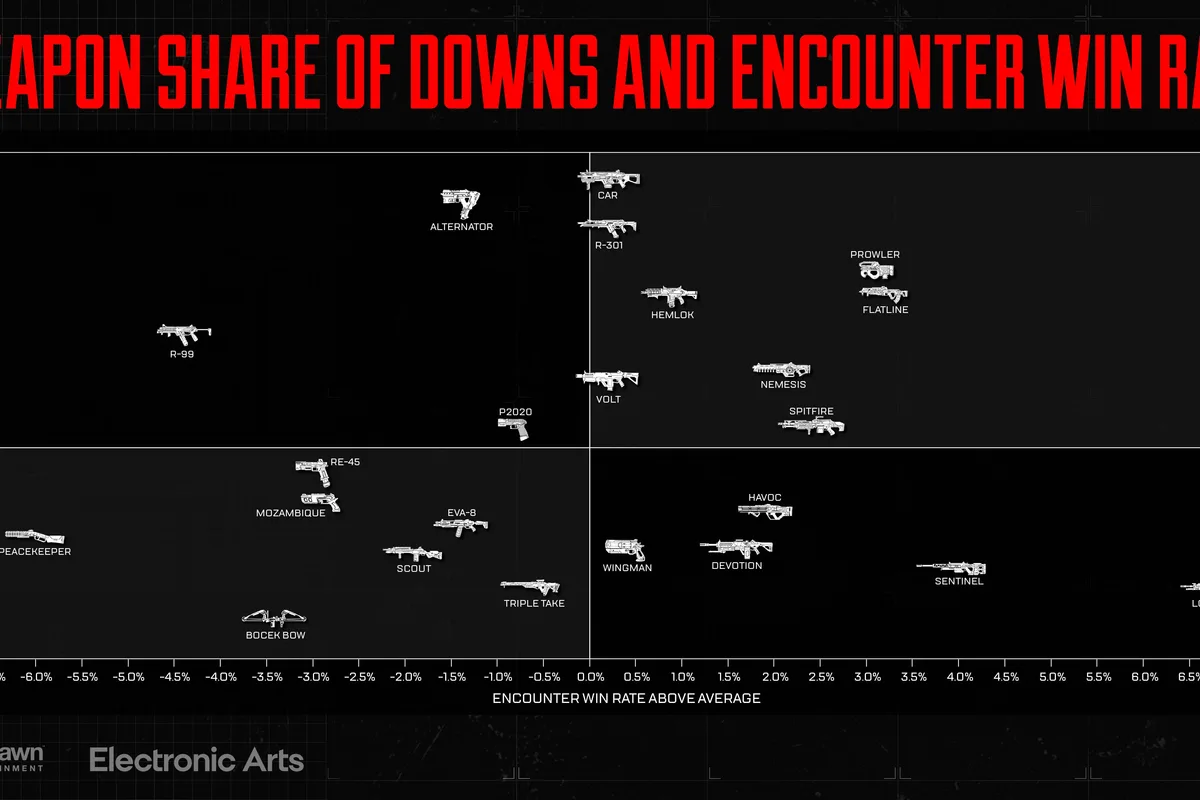
Combined with targeted nerfs to the R-99, Alternator, RE-45 and Hemlok, Respawn says these systems produced one of Apex's largest weapon-meta shifts in more than a year.
All four targeted guns declined in usage and encounter win rate, opening space for competing weapons. Several Energy weapons improved their position significantly.
Respawn's current data places the C.A.R. near the top of both share of downs and encounter performance while the Bocek sits much lower.
The team is nevertheless avoiding another enormous weapon reset at midseason.
Triple Take, Bocek and Charge Rifle are instead receiving buffs intended to bring them closer to the rest of their respective categories.
Lower-tier loot has successfully stretched the power curve
Respawn is broadly satisfied with the revamped loot progression introduced in Marked.
Season 30 reduced high-tier attachment availability, removed several easy sources of Gold loot and delayed Arsenal access until later in the opening phase of a match.
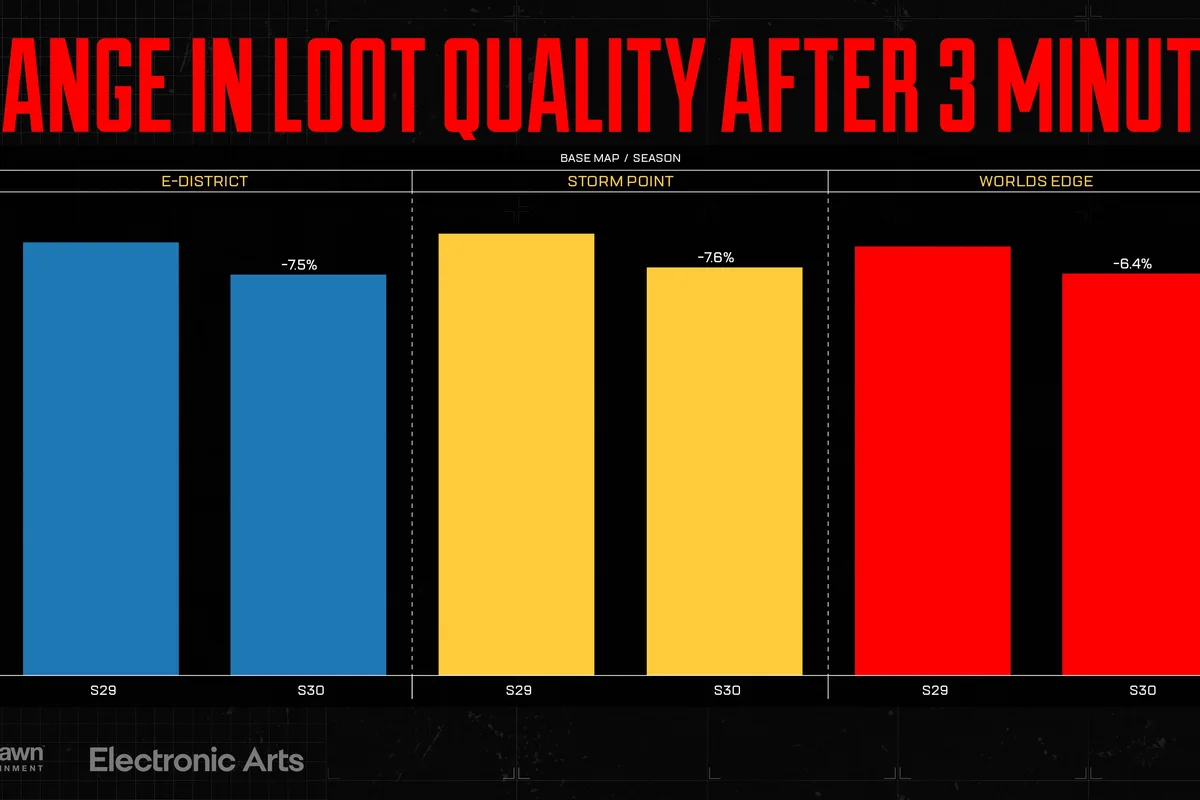
According to the studio's data, average loot quality after three minutes fell by roughly 7.5 percent on E-District, 7.6 percent on Storm Point and 6.4 percent on World's Edge under the new system.
Respawn believes that has successfully extended weapon progression deeper into matches instead of allowing power to spike almost immediately after landing.
There are still pain points.
The next update is expected to adjust healing-item spawn rates and late-game loot availability after bin resets.
The complete 30.1 patch notes arrive September 14
The Designer's Notes describe intent rather than every numerical balance value.
Respawn says the full Marked Split 2 patch notes will be published September 14.
The direction is already clear, though. After rewriting important weapon and loot rules at the beginning of Season 30, Apex is now adjusting the Legends that have to operate inside that new combat economy.
Conduit gets geometry, Fuse gets permanent explosive mobility, and Catalyst spends less time doing emergency home renovation.
For a midseason update, that is already enough to change how several squads approach a fight before the shooting even starts.