
Review
The Witcher 3 Still Makes Its Messy Systems Worth Mastering

Geralt's movement, inventory and targeting have aged more visibly than the quests around them. Yet the combination of preparation, Signs, alchemy, builds and consequence-driven contracts still gives The Witcher 3 a systemic identity few open-world RPGs have matched.
The Witcher 3's most important RPG system is not an ability tree. It is distraction. A contract that looks like ten minutes of monster cleanup can become an investigation, then an argument, then a decision whose clean solution simply does not exist.
That structure is why the open world has survived its own generation of imitators. The map is busy, certainly, but its better activities are authored situations rather than neutral pieces of content. GameSpot and PC Gamer both singled out the quality and consequence of the quest design, and that remains the part least in need of modernization.
Preparation gives the combat its character
Sword attacks alone are functional rather than exceptional. The combat becomes more distinctive when oils, bombs, potions and Signs enter the loop. Higher difficulties make enemy knowledge useful instead of ornamental, rewarding players who read the bestiary and arrive with an answer prepared.
The 2022 update's quick Sign casting matters here more than its size suggests. Removing the radial-menu interruption lets Geralt move from Quen to Igni or Yrden without breaking the rhythm of an encounter.
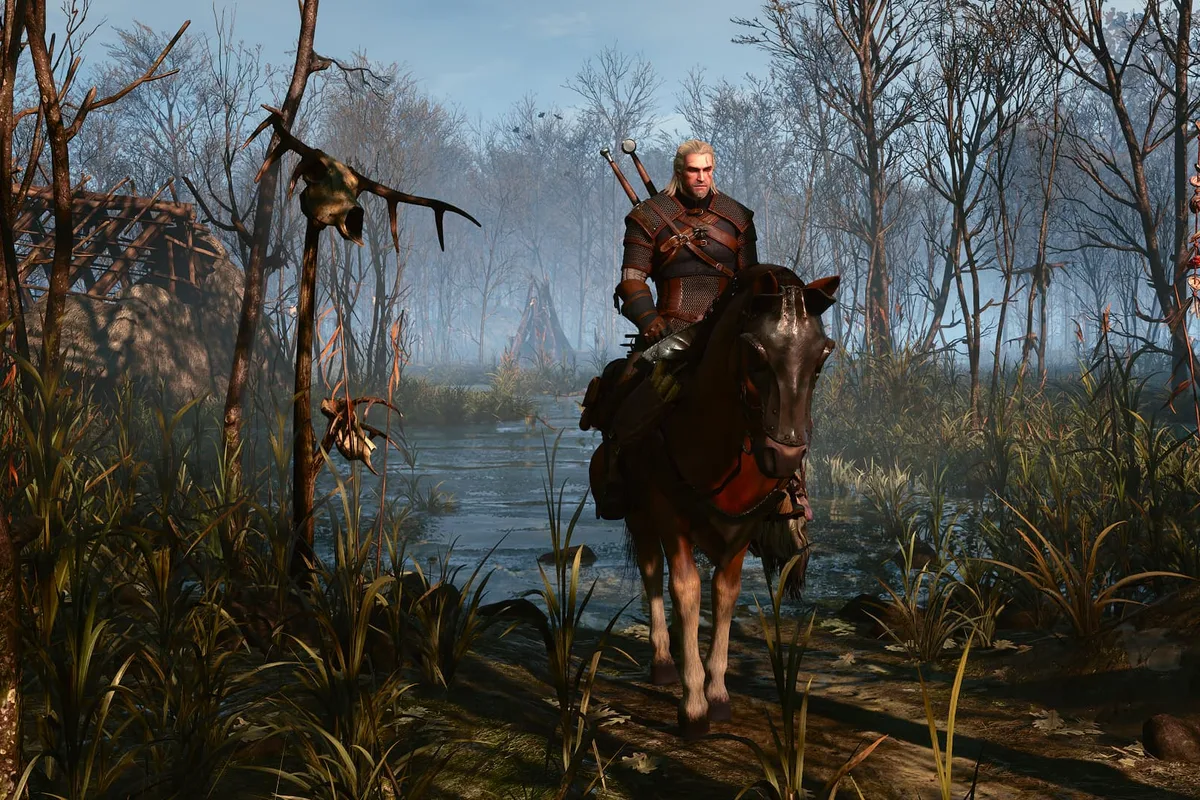
Buildcraft is broad rather than obsessive. Sword skills, Signs and alchemy can each dominate a setup, while mutagens and equipment reinforce a direction. The system rarely becomes a spreadsheet, but it gives enough room to make progression feel chosen.
Old friction has not vanished
Movement is the obvious offender. Geralt carries momentum, the lock-on system becomes awkward in crowds, and some animation commitments feel loose next to modern action RPGs. PC Gamer was identifying those issues in 2015; time has not transformed them into virtues.
Inventory management is another tax. The game produces an enormous quantity of ingredients and equipment, while crafting asks the player to care about materials that are not always pleasant to sort. The Complete Edition improved interface details but did not replace the underlying structure.
Consequences do more work than the skill tree
The better quests ask the player to make decisions before all the information is comfortable. Outcomes can surface much later, and Geralt is defined enough that role-playing means interpreting an existing person rather than inventing one from scratch.
That limitation gives the writing precision. A choice can be about Geralt, Ciri, a village or one ugly local compromise instead of feeding a universal morality meter.
Hearts of Stone and Blood and Wine extend the same philosophy well beyond the base campaign. For a game this large, the remarkable part is how often wandering away from the objective still produces something authored.
Strengths
- Side quests carry consequences instead of behaving like disposable map chores
- Signs, oils, potions and preparation sell the fantasy of actually working as a witcher
- Flexible progression supports meaningfully different combat priorities
- The Complete Edition delivers enormous breadth without making all of it feel interchangeable
Weaknesses
- Geralt's movement and target lock can still feel awkward
- Inventory and crafting friction accumulate over a very long campaign
- Routine encounters expose dated AI and animation behavior
The Witcher 3 has aged more in its controls than in its RPG design. Its strongest systems are the ones that make preparation and decisions matter, and the quality of its quest work keeps pulling those systems into situations worth caring about.