
Review
Resonance: A Plague Tale Legacy trades rats for steel, and the gamble mostly works
Asobo radically reshapes A Plague Tale around combat, exploration and puzzles. The result is brisk, beautiful and surprisingly coherent, although its melee system is far more divisive than the rest of the adventure.
This is no longer quite the same A Plague Tale
Resonance makes one sensible decision immediately: it does not pretend Sophia can simply replace Amicia inside the exact same game. She moves differently, fights differently and has no reason to reproduce the systems that defined Innocence.
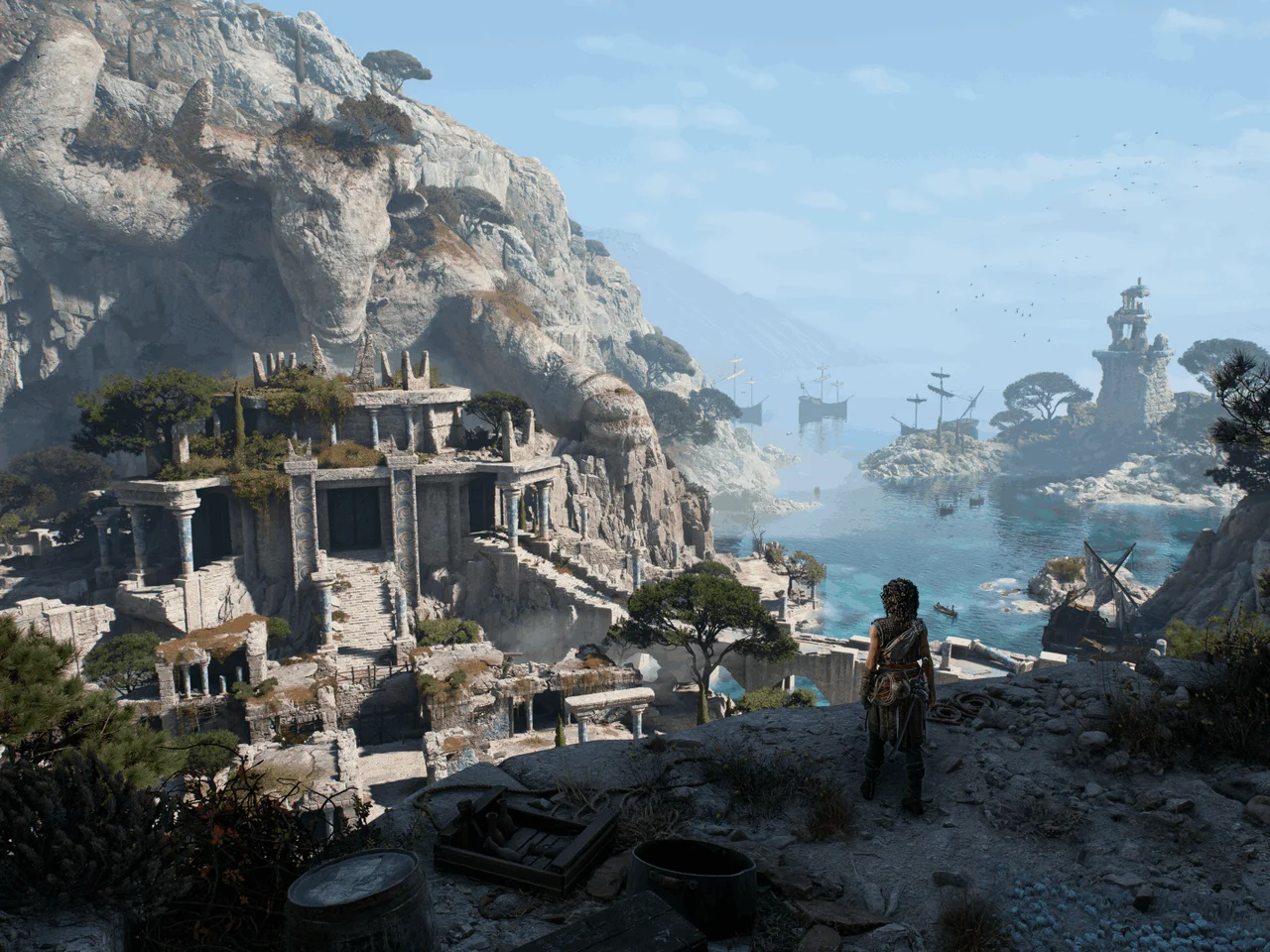
The structure is now much closer to a modern linear action-adventure. Exploration, climbing, puzzle rooms, melee encounters and large set pieces have moved to the front. Reviewers repeatedly invoke Tomb Raider and Uncharted when describing the result.
The comparison is obvious.
It is not necessarily a criticism. Resonance borrows familiar language but adapts it coherently enough to Asobo's world that it rarely feels like a generic reskin.
Sophia changes the pace
Melee is the biggest mechanical departure. Sophia attacks, blocks, parries, kicks and uses her grappling hook to disrupt opponents. Encounters are no longer built around avoiding visibility at almost any cost.
That makes the game considerably faster and more confrontational.
It is also where critics disagree most sharply. PlayStation Universe and Windows Central found the swordplay satisfying and responsive. Wccftech, PCGamesN and TechRadar were substantially less convinced.
Combat is the weakest part of the reinvention
The same complaints recur across several reviews. Sophia's offensive toolkit is limited, groups of enemies can crowd her, and camera positioning becomes unreliable when threats approach from multiple angles.
Wccftech additionally points to how little punishment Sophia can absorb, making mistakes feel harsher than the relatively straightforward combat system can always justify.
The issue is not that fighting is constantly broken. It is that the campaign asks enough of the system for its limited depth to become obvious.
Resonance is usually better when the swords go away.
[image:site1_resonance_hero]
Puzzles fit the adventure more comfortably
Minotaur's Island revolves around light, lenses, mirrors and a stolen Minoan sphere used to expose clues and activate mechanisms.
The better chambers ask players to read the environment before manipulating it. Windows Central considers the puzzle design more developed than in previous entries, while Wccftech praises the general difficulty balance.
Those ideas eventually repeat, though. Redirecting light is less exciting the tenth time than the first.
An optional hint system prevents individual puzzles from destroying the campaign's pacing.
The pursuit sequences recover old Plague Tale tension
Resonance does not completely abandon the series' fascination with threats that cannot simply be killed.
Later horror-leaning sections force Sophia back into hiding, observation and movement through spaces occupied by something far more dangerous than another soldier.
Several reviews identify these sequences as highlights. They restore the sensation that survival depends more on reading the environment than winning another arena fight.
Fourteen or fifteen hours is mostly the right size
The campaign generally lands around the fourteen-to-fifteen-hour mark. Siliconera specifically praises that restraint, presenting Resonance as a welcome alternative to games built around dozens of hours of progression systems.
The focused length suits it.
Wccftech nevertheless argues that ten to twelve hours would have been tighter, and the criticism becomes understandable once combat arenas and familiar puzzle concepts begin repeating late in the game.
The reinvention matters more than the imperfections
Players who define A Plague Tale exclusively through the stealth and helplessness of Innocence may find Resonance too conventional.
Repeating Innocence with Sophia would have been far less interesting.
Asobo's new mixture of melee, exploration and puzzle-solving is uneven, with combat clearly the component that needs another iteration. Yet it is energetic, coherent and distinct enough to justify turning a former supporting character into the center of her own game.
For a spin-off trying to change the rules, that is a substantial success.
Strengths
- A genuine reinvention rather than another Requiem
- Exploration and puzzles fit naturally into the campaign's pacing
- Sophia's mobility and aggression materially change how the game plays
- Pursuit and horror sequences recover classic Plague Tale tension
- A focused campaign of roughly fifteen hours
Weaknesses
- Melee combat is considered too simple and occasionally frustrating by several reviewers
- Camera behavior and enemy crowds can make some arenas messy
- Several puzzle mechanics eventually repeat themselves
- The back half would benefit from fewer mandatory fights
Resonance succeeds because it does not try to mechanically recreate Innocence or Requiem. Sophia produces a faster, more aggressive game closer to traditional action-adventure, while puzzles and pursuit sequences preserve enough tension to retain the A Plague Tale identity. Combat keeps that reinvention from reaching its full potential: shallow options, camera problems and repetitive encounters are the most consistent weaknesses across the review corpus. Even so, Asobo has built a strong, compact spin-off that feels different for a reason.