
News News Official
Becastled adds over 40 traits and new magic units that could completely reshape your strategies
Becastled's Traits and Some Magic DLC is available as of October 22, 2026, introducing more than 40 traits designed to challenge established strategies. Some improve resource production, while others dramatically increase combat power at the cost of severe limitations. Two new units, Mages and Clerics, expand the tactical possibilities with area damage and healing.
 By Hugat
Strategy games can become predictable once players discover an approach that works consistently.
A particular army composition, building order or defensive layout may gradually become the default choice.
Pingle Studio noticed that problem in Becastled and wanted to create more reasons to experiment.
Its Traits and Some Magic DLC introduces over 40 traits intended to encourage players to adapt their decisions to the circumstances of each run.
The expansion also introduces two new magical units, giving armies additional offensive and defensive options.
Choose one trait from three options
Every few in-game days and after a Blood Moon, players are offered three traits and must select one.
Traits come in three rarity categories: Common, Uncommon and Rare.
Following a Blood Moon, rarer options become more likely to appear.
Some traits provide straightforward improvements to economic production or unit health.
Others offer much stronger advantages in exchange for restrictions that can fundamentally change the player's strategy.
This means players cannot simply select one opening plan and repeat it throughout every game.
They need to evaluate new possibilities as the run progresses.
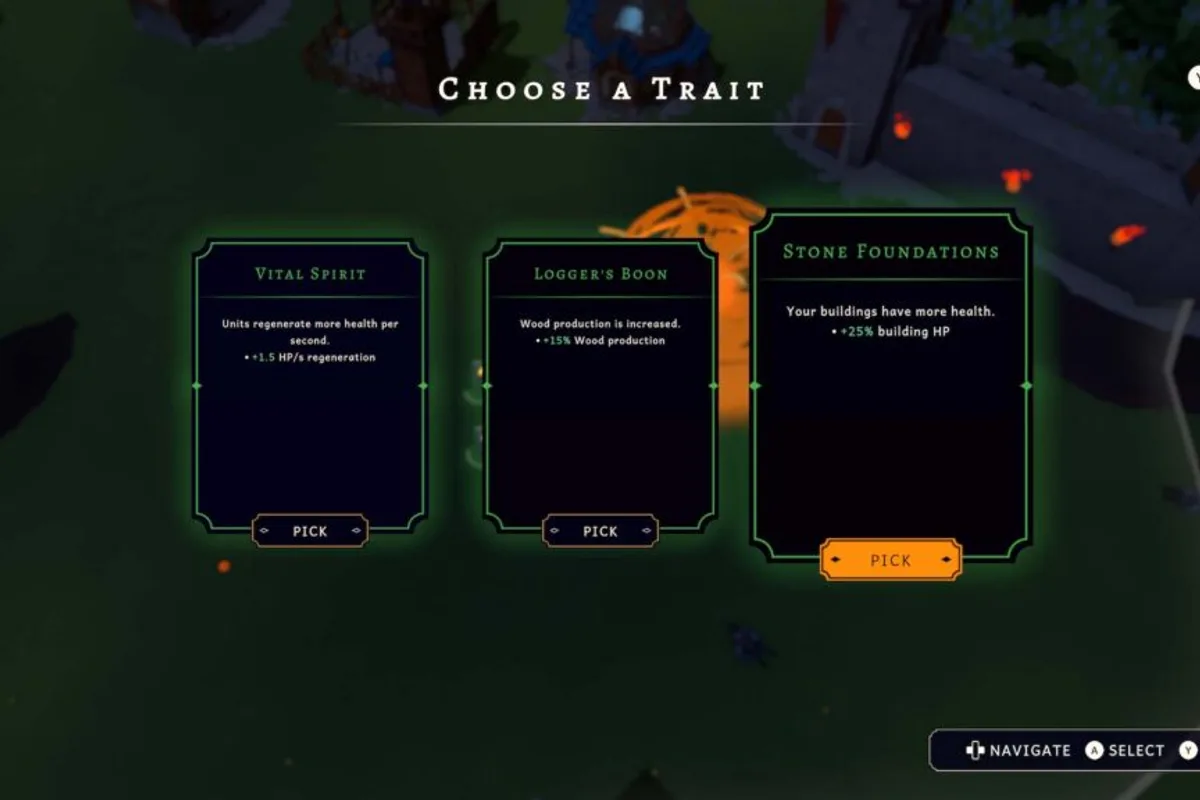
Offering three options preserves uncertainty while giving players an opportunity to make meaningful decisions.
The intention is to encourage adaptation rather than the automatic accumulation of upgrades.
Master of the Bow creates an army of archers
One of the most dramatic examples is Master of the Bow.
This trait restricts the player to archers but significantly increases their damage output.
The advantage is obvious when defending from safe positions or attacking enemies at range.
However, the restriction removes the flexibility normally provided by other unit types.
Players may need to redesign their defenses around protecting archers and maintaining favorable firing positions.
A powerful ranged army can still struggle if enemies close the distance.
The trait therefore changes more than numerical statistics.
It establishes a distinct tactical identity for the run.
Glass Cannon trades survivability for damage
Glass Cannon reduces unit health while increasing their damage.
The value of that trade-off depends on the surrounding strategy.
Units that are already vulnerable may become too fragile to survive important battles.
On the other hand, a well-protected army might benefit considerably from additional damage.
Pingle Studio describes a combination involving Glass Cannon, Blood Money and Master of the Bow.
Together, these traits can produce archers capable of inflicting extremely high damage.
However, powerful combinations do not guarantee victory.
Positioning, enemy behavior and the army's reduced resilience remain significant factors.
Manifest Destiny changes the economics of expansion
Not every trait is focused on combat.
Manifest Destiny reduces population mood while allowing players to acquire several upcoming zones for free.
The economic advantage can be substantial.
Resources that would normally be spent on territorial expansion become available for buildings, production or military investment.
The reduction in mood introduces another problem.
Players need to maintain a functional settlement while dealing with the trait's downside.
A stable economy may be able to absorb that cost.
A settlement already struggling with citizen satisfaction may find the same trait much more difficult to use.
Its value depends on the state of the kingdom rather than a universal ranking.
Mages bring powerful but fragile area damage
Traits and Some Magic also introduces the Mage School.
The building allows players to recruit Mages and Clerics.
Mages specialize in dealing significant damage, particularly against groups of enemies.
Their area attacks can eliminate multiple opponents when positioned effectively.
However, they have low survivability.
Pingle Studio recommends placing them where they can attack while remaining protected.
Walls can offer suitable positions, while stronger units can protect Mages from enemies approaching on the ground.
Their usefulness depends heavily on positioning.
A Mage eliminated early in a battle may contribute very little despite its potential damage output.
Clerics help keep soldiers alive
Clerics play a different role.
Rather than focusing on damage, they heal other units.
Pingle Studio wanted to address the repeated loss of soldiers during difficult encounters, particularly boss fights.
Clerics can help established formations survive for longer periods.
The studio highlights their synergy with Swordsmen.
A sturdy frontline supported by healing can become considerably more resilient.
However, Clerics are vulnerable themselves.
Enemy archers and other attackers can eliminate them quickly if they are exposed.
Their inclusion therefore introduces an additional defensive responsibility.
Players must protect the units responsible for keeping the rest of the army alive.
Positioning becomes increasingly important
The two new magical units share a common weakness.
Both require protection to deliver their maximum value.
Mages must be close enough to affect groups of enemies but protected from direct attacks.
Clerics need access to injured allies while avoiding exposure to hostile units.
These requirements make formation design and defensive placement increasingly important.
Strong walls alone may not be sufficient if essential support units are positioned poorly.
Trait effects create additional complications by changing unit statistics and imposing restrictions.
The best strategy will depend on the available units, terrain and modifiers selected during the run.
The DLC is designed to disrupt established strategies
Game designer Bogdan Pavlenko explains that the team deliberately avoided making every trait a purely positive upgrade.
When all available choices provide benefits without drawbacks, selecting the strongest numerical improvement can become relatively straightforward.
More meaningful restrictions create harder decisions.
A powerful damage increase may be valuable in one situation and dangerous in another.
Traits can also interact in ways that alter their individual usefulness.
A modifier that seems relatively weak on its own may become important when combined with another effect.
The system is built around evaluating those synergies and adapting plans accordingly.
Balancing more than 40 traits with a small team
Creating dozens of interacting modifiers presents a challenge for a relatively small development team.
Pingle Studio designed the system so game designers could create new traits without requiring constant programmer involvement.
This approach made it easier to introduce new options and test them during development.
The studio used internal playtests and spreadsheet formulas to examine values and combinations.
Balancing individual traits is only part of the challenge.
Several simultaneous modifiers may produce much stronger effects than their individual descriptions suggest.
Those interactions need to be considered when assessing the overall balance.
A more flexible modifier system was considered
Pingle Studio also experimented with a separate system that would allow players to select modifiers before starting a game.
The concept did not impose a fixed limit on the number of active modifiers.
Players could theoretically create extremely difficult challenges by combining many restrictions.
They could also disable certain mechanics, including mood or the unit limit.
However, the team did not have enough time to complete that feature.
It is not included in Traits and Some Magic.
The experiment illustrates the developers' design intentions rather than confirming a future addition.
Another reason to rebuild your kingdom
Becastled retains its familiar structure of building a settlement during the day and defending it against the forces of the Moon at night.
Traits and Some Magic does not replace that foundation.
Instead, it aims to change the decisions players make within it.
An established defensive strategy may become less effective when a trait restricts unit choices.
A fragile army might need to prioritize protection, while a healing-focused formation could support longer engagements.
The DLC is confirmed as available on October 22, 2026.
Whether its combinations remain balanced over time will require observation beyond the developer's internal playtests.
Its central idea is nevertheless clear: rather than searching for one universally effective strategy, players are encouraged to build an army suited to the unusual circumstances of each run.