
News News Official
Gaming Is Growing Again, but Studios Are Still Paying for the Boom
The global games business is forecast to approach $214 billion in 2026. That sounds like the end of the crisis. Inside studios, it does not feel much like one: teams are still being cut, giant projects remain increasingly difficult to finance, and player attention has become one of the industry's most expensive resources.
 By Kader
Revenue is back before confidence is
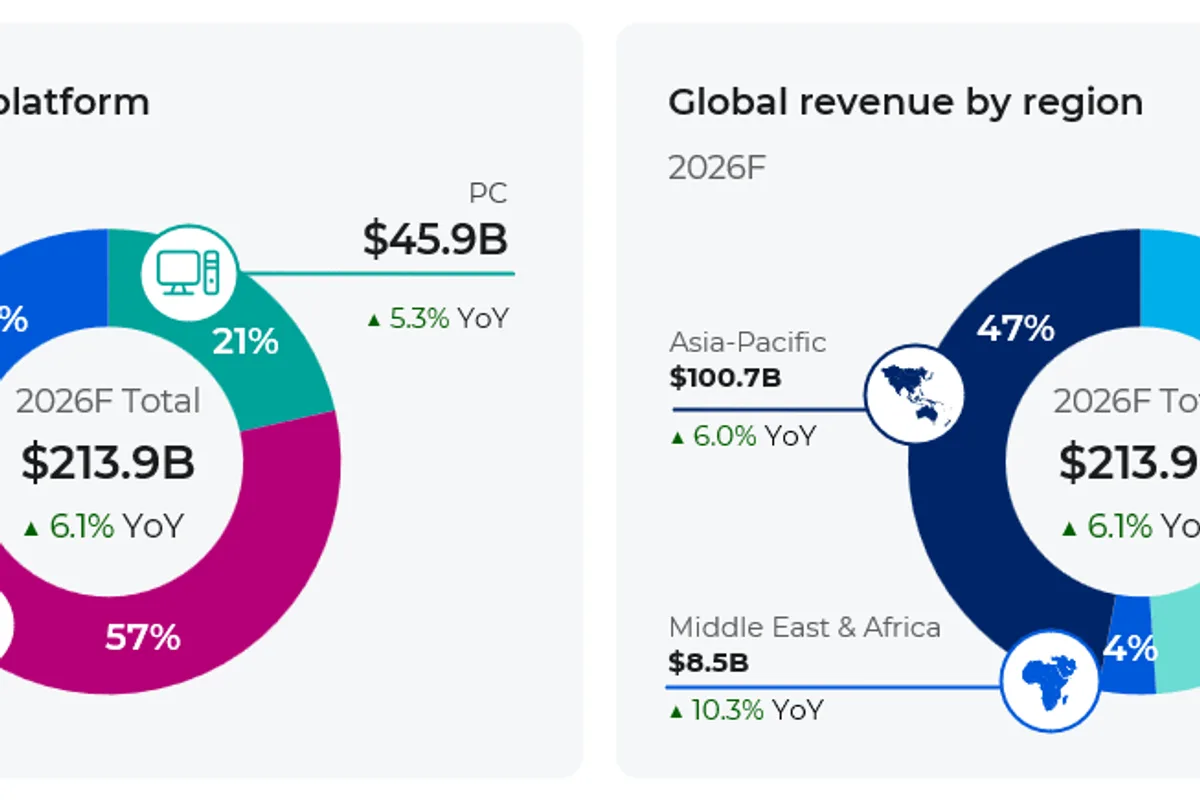
Newzoo forecasts $213.9 billion in global games revenue for 2026, a 6.1 percent increase year over year. Mobile remains enormous at $121.1 billion, while console is expected to generate $46.9 billion and PC $45.9 billion.
All three platforms are growing. After the post-pandemic plateau, that matters.
The composition of that growth is less comforting. The worldwide player base is expected to reach 3.7 billion this year, but Newzoo expects player growth to slow over the remainder of the decade.
The next expansion cycle increasingly depends on keeping existing audiences engaged and monetising them more effectively rather than continuously discovering huge new populations.
The scarce resource is attention
Gamescom 2026 made the industry's competitive problem unusually visible. Newzoo's analysts argued that publishers are no longer competing only against other games. They are competing against TikTok, YouTube, streaming television and every other activity trying to occupy the same evening.
Steam saw roughly 20,000 releases in 2025.
Meanwhile, games that launched five, ten or fifteen years ago continue to hold enormous communities. A new release does not enter an empty marketplace. It arrives beside products that have accumulated years of content, friends, habits and sunk time.
The middle of the market has room again
One of the more encouraging shifts is happening below traditional AAA pricing. Newzoo identifies the $30 to $50 premium tier as one of the fastest-growing parts of the PC and console market.
That range creates room for AA productions, focused multiplayer games and ambitious independent titles that can offer something increasingly difficult for an $80 blockbuster: a price that visibly matches the scope of the project.
On PC, games outside the Top 20 accounted for 42 percent of playtime in 2025, up from 33 percent in 2022.
The market is crowded, but it is not completely sealed by the largest publishers.
Employees have not experienced the recovery yet
The labour picture remains severe. GDC's 2026 State of the Game Industry survey found that 28 percent of respondents had been laid off during the previous two years. Among US respondents, the figure reached 33 percent.
Seventeen percent reported losing a job during the most recent twelve months, and a significant portion of those laid off remained unemployed when surveyed.
The restructuring continued through the year. Microsoft announced 4,800 job cuts in July, with around 3,200 affecting Xbox as the gaming division was reorganised and multiple studios moved out of its existing structure.
By September, Don't Nod was warning that another restructuring could eliminate as many as 90 positions.
Technology solved some production problems and created new ones
Modern games are expensive long before marketing begins. Real-time cinematics, sophisticated animation, online infrastructure, cross-platform accounts, localisation, accessibility features and years of post-launch support all require specialised teams and tooling.
Hardware progress does not automatically reduce the bill. Higher ceilings create higher expectations.
An engine can make an open world faster to assemble while the project simultaneously adds denser assets, more platforms and a network layer that did not exist in the previous generation.
Generative AI is already here, enthusiasm is not
Thirty-six percent of professionals surveyed by GDC say they use generative AI somewhere in their work. Research and brainstorming are the most common applications, followed by everyday tasks, code assistance and prototyping.
Sentiment has moved in the opposite direction. Fifty-two percent now believe generative AI is having a negative impact on the games industry, up from 30 percent in 2025 and 18 percent in 2024.
The most negative groups are among the disciplines closest to actual game creation: visual and technical art, design and narrative, and programming.
Usage is increasing while trust is collapsing. That contradiction may define the next few years better than any demonstration video.
Bigger technology is no longer a business model
Players still notice visual ambition. They also increasingly distinguish between technology that changes the experience and technology that merely increases the production bill.
Some of the strongest commercial stories now come from projects with much narrower scopes, clearer identities and lower prices. That does not mean AAA games are disappearing. It means technical scale can no longer justify itself automatically.
The industry is recovering into a different shape
2026 is therefore difficult to describe as either healthy or broken. Revenue is growing. Premium spending has returned. Capital appears to be moving again.
At the same time, companies are reducing headcount, relying more heavily on established IP and reassessing portfolios around projects that can survive a much harsher market for attention.
At Gamescom, Newzoo described the prevailing mood as realistic rather than bleak.
That may be the most accurate summary. The industry is no longer waiting for the old conditions to come back. It is beginning to build around the possibility that they will not.