
News News Official
He Who Watches is out, and the ceiling is part of the puzzle
He Who Watches launched on September 2, bringing its gravity-bending dungeon to Steam and itch.io. Its trick is not merely letting players walk on walls. Every change in orientation forces the same room to be reconsidered from scratch.
 By Hugat He Who Watches
The bow in He Who Watches looks like the obvious tool until the game makes clear what it is not for. There is no combat loop built around firing arrows at enemies. Instead, one magical arrow moves blocks, operates switches, opens doors and creates chained connections across gaps.
That restraint matters because the rest of the puzzle space is already doing plenty of work. Players can move onto walls and ceilings, shift their relationship with gravity and treat surfaces that would normally be scenery as valid pathways. Bobby Vanden uses that idea as the foundation for more than 100 handcrafted puzzles.
Sokoban logic turned sideways
Block manipulation gives the game a recognisable Sokoban-like backbone, but the first-person presentation makes spatial reasoning the real complication. A block that appears to be sitting safely on the floor may effectively be hanging from a wall after the player's orientation changes. Routes, switches and arrow trajectories all have to be reconsidered with it.
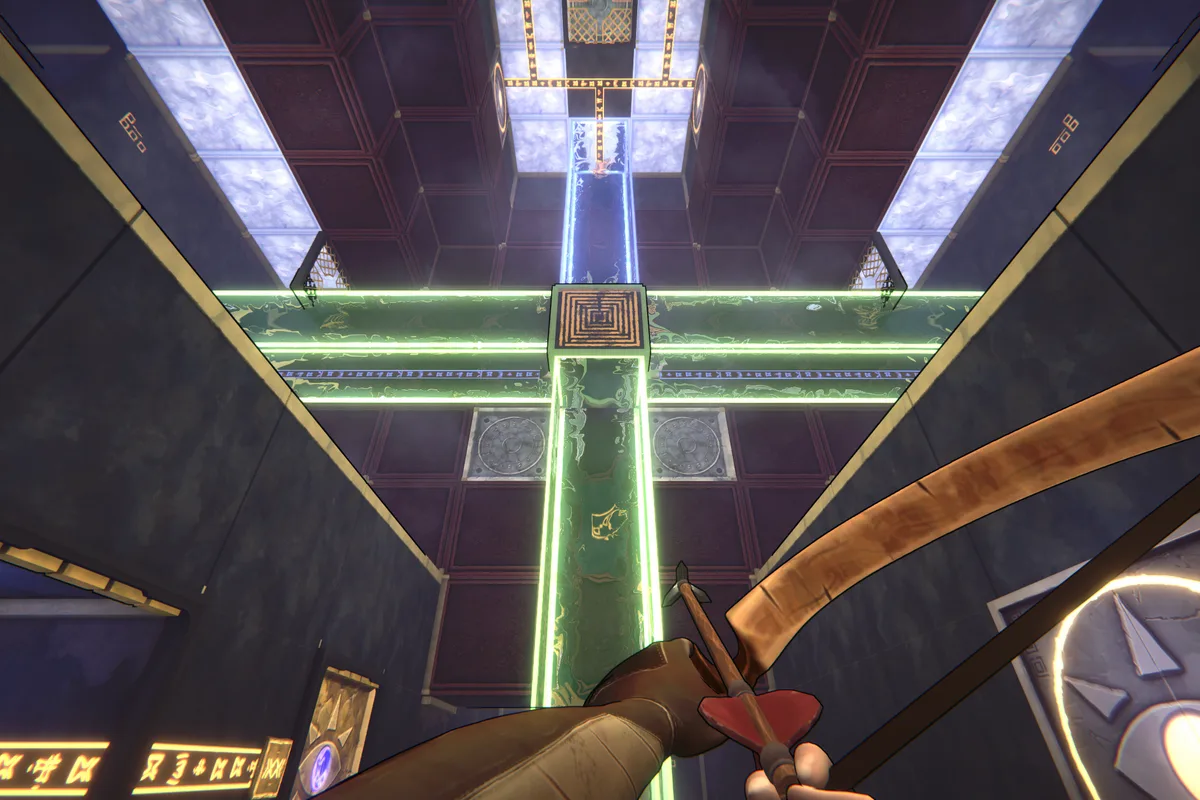
The rules are designed to grow in complexity rather than arrive all at once. Later rooms combine mechanics that were previously introduced separately, while a playable hint system can provide guidance when a solution stops being obvious. The stated goal is to preserve the reasoning rather than simply display an answer.
There is more in the dungeon than the main route
He Who Watches also uses its labyrinth as something to investigate. Secret paths, hidden mechanics and recurring symbols sit beyond the core puzzle sequence, with an imprisoned god waiting somewhere near the centre of the structure.
That side of the game draws from the curiosity-driven design of titles such as Fez and Tunic. Progress therefore has two rhythms: solving the explicit room in front of you and noticing that the wider labyrinth may be asking a different question altogether.
The official press materials estimate roughly 10 to 15 hours for the main experience, with additional time for secrets. He Who Watches released on September 2, 2026 for PC and macOS through Steam, with an itch.io version also available.