
News News Official
itch.io removes terabytes of AI spam and expands its No AI game filter
itch.io is responding to a surge in automated submissions with expanded generative AI filters and a substantial moderation cleanup. On November 3, 2026, the independent games platform announced that No AI filtering would be available in more discovery tools, including search results. It also reported removing several terabytes of unwanted AI-generated material.
 By Kader
An open storefront is a valuable thing for independent developers. itch.io has built much of its identity around allowing creators to publish unusual games, unfinished experiments, game jam projects and personal work without going through a conventional publisher.
That openness becomes harder to manage when creating a new game page is considerably easier than attracting an audience. According to the platform, the number of pages created every day has doubled over the past two months, while downloads and purchases have not experienced a comparable increase.
itch.io has not established that every additional page comes from generative AI. It has, however, acknowledged the problems created by large quantities of automatically generated submissions, and its latest response combines stricter moderation with new discovery controls.
No AI filtering reaches search results
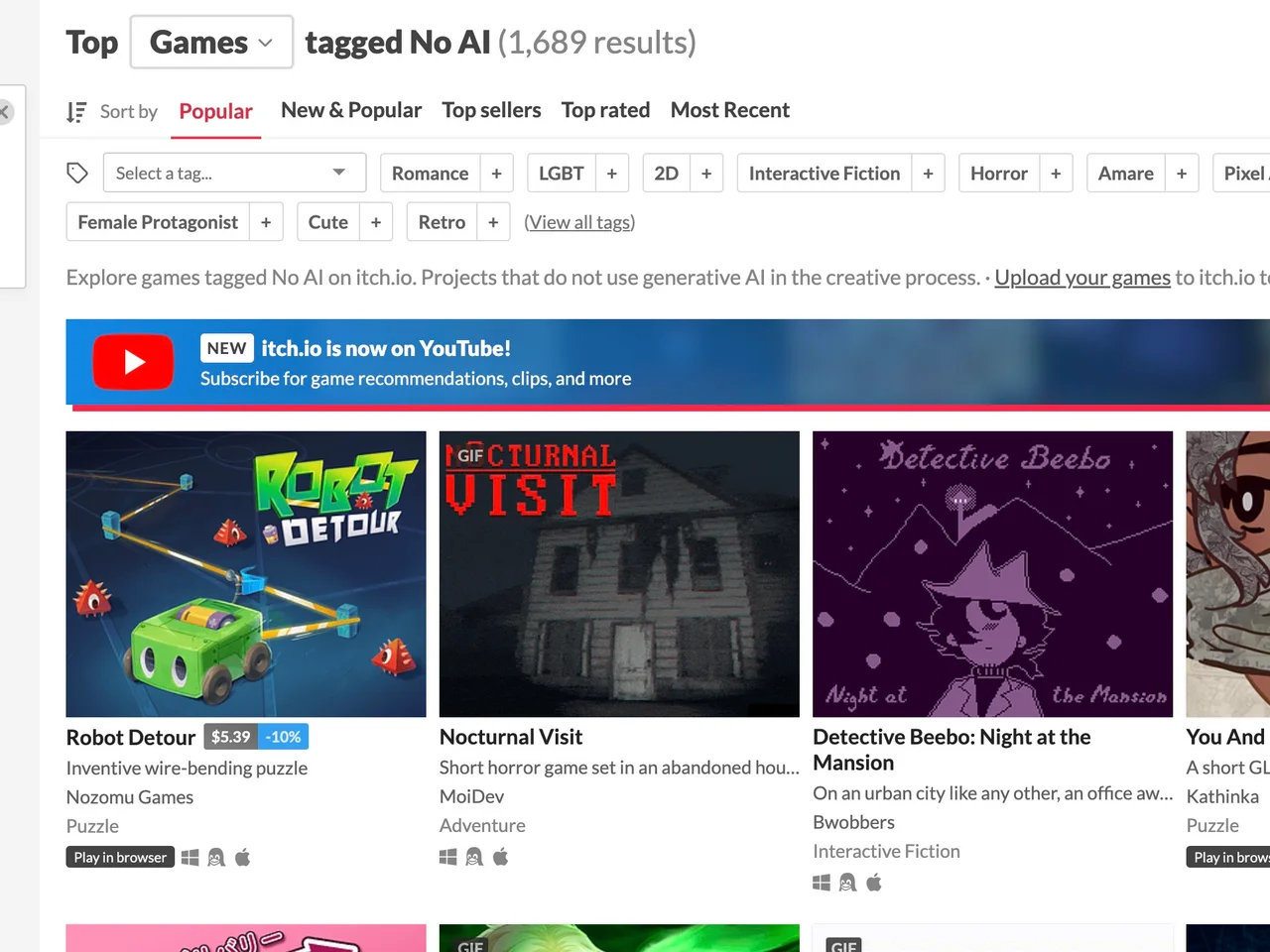
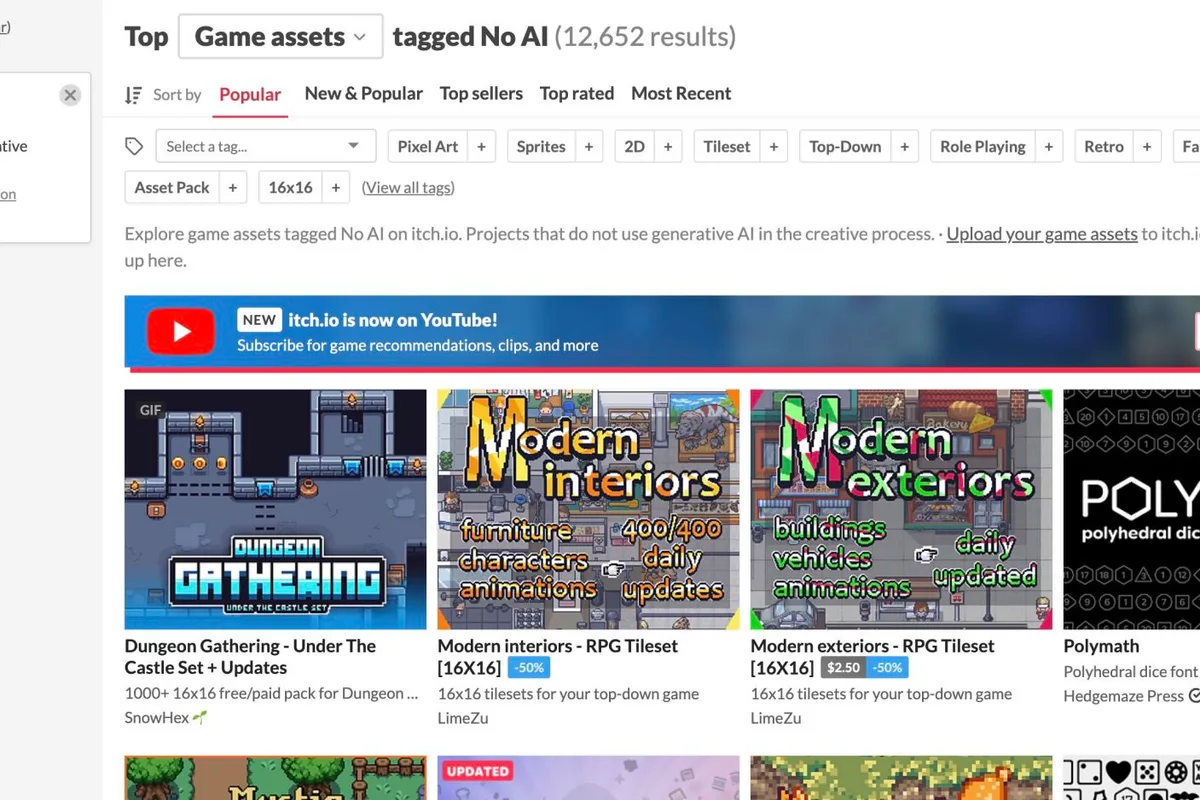
The most immediate change is an expansion of itch.io's existing generative AI disclosure filters. Visitors can now apply the No AI option in additional parts of the storefront, including the search interface.
The filter focuses on projects whose creators explicitly state that no generative AI was used in their creative process. It is not an automated detection system that examines every game and determines how its assets or code were produced.
This distinction matters because the system relies on the declarations attached to project pages. A game whose creator has not completed the relevant disclosure may be absent from the filtered results, even if its development involved no generative AI.
Engadget reported that, on November 3, applying the filter reduced the number of visible games from more than 1.77 million to fewer than 425,000. That difference should not be treated as the number of AI-generated games hosted by itch.io.
The missing results also include projects that lack an explicit No AI declaration. As a result, the filtered count provides information about discoverability and metadata, rather than a reliable measurement of generative AI adoption.
For players who prefer handmade assets or wish to avoid generative AI entirely, the feature offers a more convenient way to browse. For developers, completing disclosure fields has become more important.
The cleanup targets mass-produced content
Alongside the filtering changes, itch.io reported deleting several terabytes of material it described as unwanted AI-generated content.
The platform has not published a verified count of the individual games or projects removed. It also referenced users uploading extremely large quantities of poorly optimized generated models, including an example involving ten terabytes. That example should not be confused with the volume actually deleted.
itch.io's official quality guidelines have prohibited excessive automatically generated submissions for more than two years. The rules specifically address projects created predominantly by algorithms with minimal human intervention, randomly generated content with little curation, and repeated versions of essentially identical products.
The policy does not prohibit all uses of generative AI. Creators can still incorporate generated material when it is accurately disclosed and their projects provide meaningful value to the community.
Moderation can also take several forms. A project may be removed from browsing, search and recommendation indexes while remaining accessible through its direct link or the creator's profile.
Disclosure is becoming part of discoverability
The new controls cover different categories of generative AI use. Graphics, audio, written content and code can be distinguished in the disclosure system, allowing users to refine their browsing preferences.
Traditional procedural generation and established game AI techniques are not treated as generative AI under itch.io's rules. Enemy pathfinding, procedural levels and dynamic difficulty systems do not automatically trigger the same disclosure requirements.
This helps establish a practical boundary between conventional game development techniques and tools designed to produce new content using models trained on large datasets.
That boundary is still dependent on developers describing their work accurately. Filters can organize information supplied to a storefront, but they cannot establish the entire production history of a game.
Why independent creators have reason to care
Visibility is a limited resource on any digital storefront. It is particularly valuable on itch.io, where individual creators often have little marketing budget and rely heavily on browsing categories, recommendations and community discovery.
A sharp increase in the number of published pages creates more competition for attention. It does not automatically mean that the number of genuinely interesting projects has increased at the same rate.
The ability to exclude certain categories may make discovery more manageable for users. Yet it introduces another complication for creators whose older projects were published before modern disclosure requirements existed.
If a page lacks the necessary metadata, it may be left out of the No AI results regardless of how the game was made.
The platform is therefore balancing two priorities: keeping its open publishing model intact while making the resulting catalog useful enough for visitors to explore.
The No AI designation should not be mistaken for a quality certification. It addresses a declared production choice, not whether a game is entertaining, well-designed or technically polished.
The rules now extend beyond digital games
itch.io is also expanding mandatory generative AI disclosure to additional creative categories, including physical tabletop games, books, comics and soundtracks.
Game assets were already subject to stricter disclosure requirements. The expanded approach reflects the storefront's wider role as a publishing platform for independent digital and physical creative work.
The changes arrive as other gaming marketplaces continue to debate how automated submissions, AI-assisted production and increasingly crowded catalogs should be handled.
For itch.io, the immediate answer is not a universal ban. It is a combination of moderation against excessive automated publishing and more granular control over what visitors choose to see.
The expanded filters were announced on November 3, 2026, and are available through the site's search and discovery interfaces. Their effectiveness will continue to depend on accurate creator disclosures and the platform's ability to identify problematic submissions.