
News News Official
Hanok: From Thatch to Palace Wants to Teach Building Before Letting Players Break the Rules
A city builder will usually let a house appear with a click. Hanok: From Thatch to Palace would rather explain why the pillar goes up before the wall. WATSI is scheduling its construction game for Steam on September 29, 2026, with a progression stretching from a small thatched cottage to Korean palace buildings. Once those lessons are understood, the historical construction rules can even be switched off. The game teaches the proper method first, then politely allows players to ignore it.
 By Kader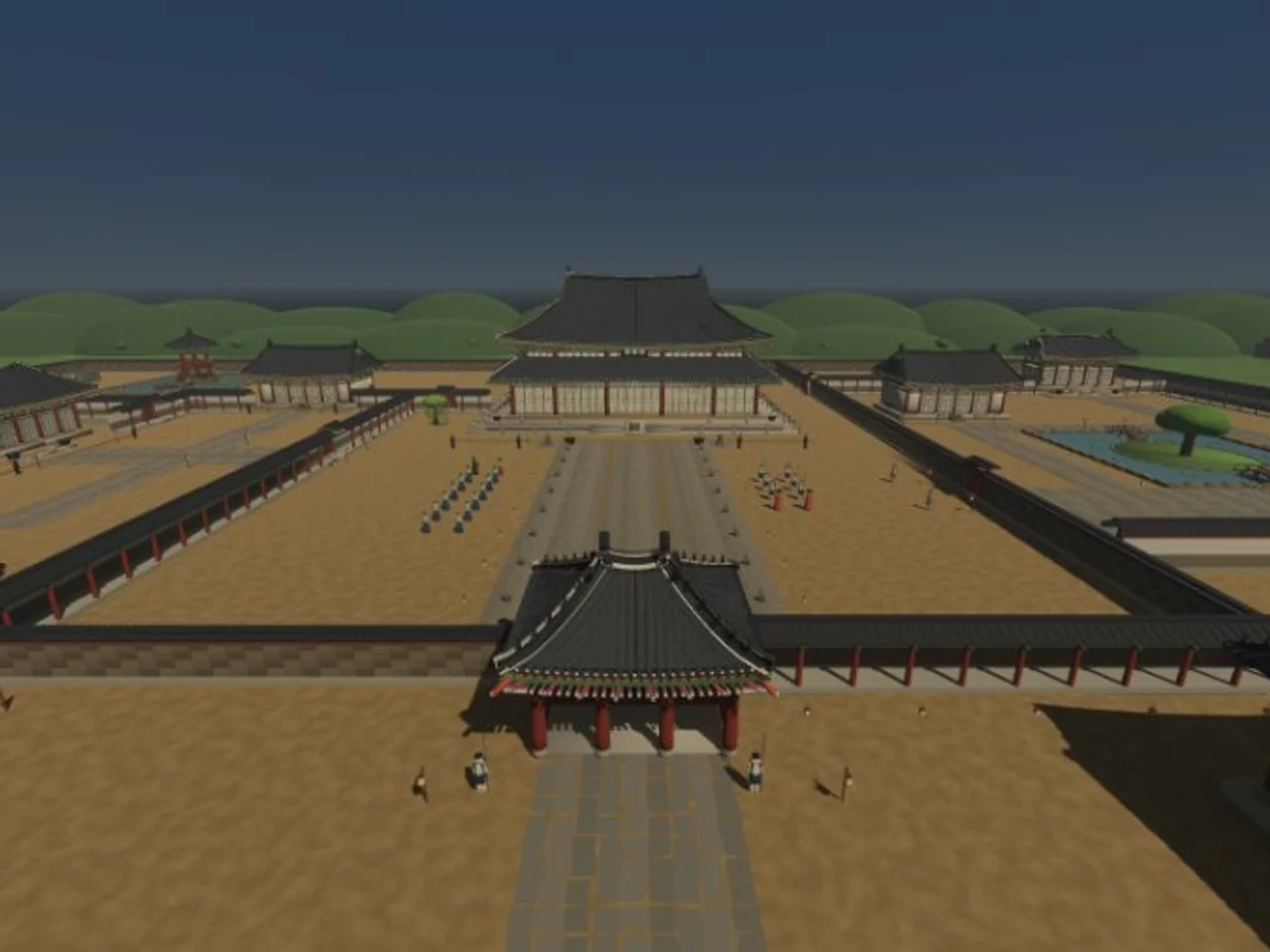
Eleven buildings for understanding how a hanok stands
The guided mode does not treat structures as finished models that appear once enough resources have been collected. Foundation stones, pillars, beams, purlins, rafters and roof tiles are placed according to the traditional construction sequence: frame first, roof next and walls afterward.
The progression contains eleven guided builds. It begins with a three-bay thatched cottage, moves through an L-shaped farmhouse and several tiled-roof structures, then reaches a seowon lecture hall, palace buildings, a gate tower and a two-story pavilion over a pond.
Every component carries its real name and a short explanation of its function or placement. WATSI names the National Folk Museum of Korea, Korea Heritage Service and Encyclopedia of Korean Culture among its sources. The game also includes a page identifying details simplified for play and areas the developer says it could not confirm.
After the lessons, 210 pieces enter the sandbox
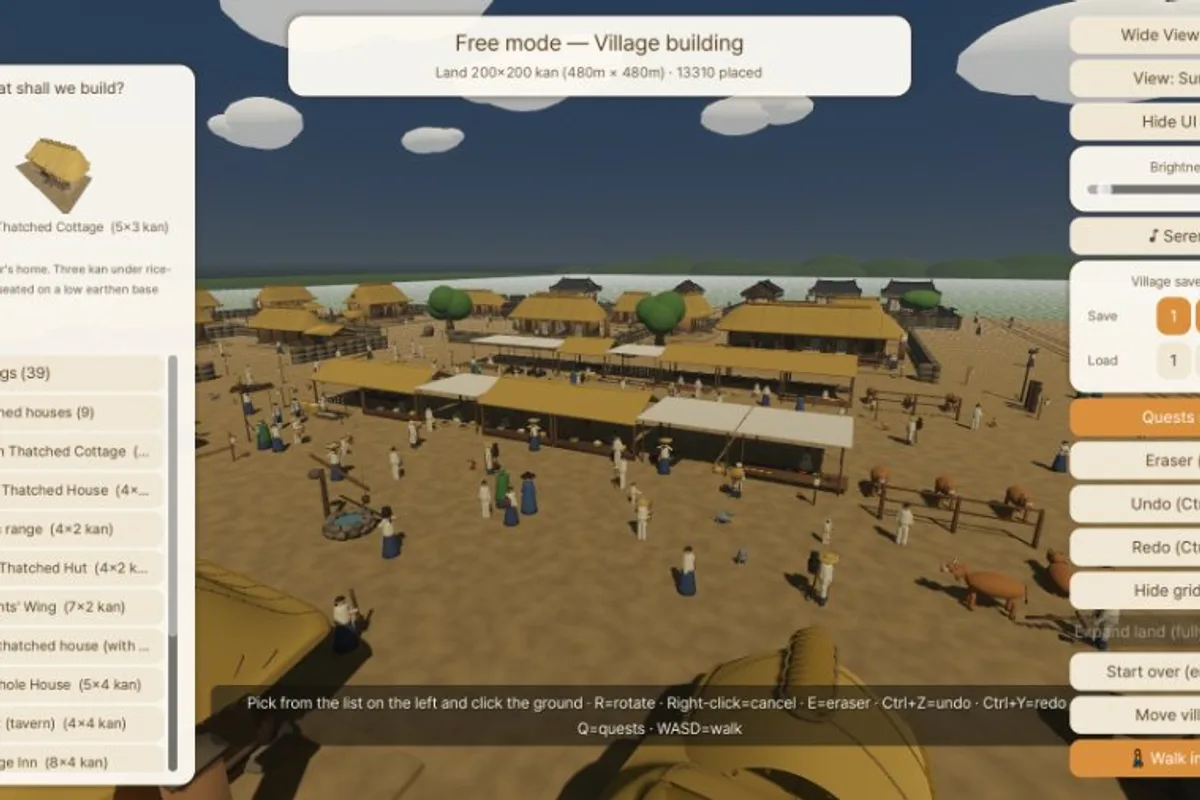
The creation mode considerably expands the scale. Steam lists 210 pieces covering thatched and tiled houses, palace halls, government offices, walls, gates, corridors, streams, bridges, city ramparts, rice paddies, market stalls and lanterns.
Forty types of townsfolk and eight farm animals can populate those settlements. Construction tools also allow whole walls, paths and paddies to be dragged out instead of requiring every segment to be positioned individually.
Six commissions give the town a purpose
Players who prefer some structure to a completely open sandbox can take on six building commissions. These include a farming village, market street, nobleman's house, village of nobles, palace throne-hall compound and royal rear garden.
Individual houses can be constructed separately and then placed into the larger town. House-building mode allows the historical order of construction to remain enforced or be disabled, leaving players free to experiment with the available pieces beyond traditional practice.
The finished town can be explored from ground level
Once enough has been built, players can enter their town on foot while dressed as the king. Structures can be walked through, while four times of day change their presentation: dawn mist, daylight, sunset and a moonlit night in which lanterns and window paper glow.
Eleven pieces of traditional Korean music accompany construction. The game itself is single-player, with Steam Family Sharing also listed among its features.
The Korean launch falls on September 29
WATSI's official website dates the PC Steam launch to September 29, 2026, while Korean coverage specifies 10:00 a.m. local time. Steam may display September 28 depending on the storefront timezone, while its unlock data corresponds to September 29 at 01:00 UTC. The September 29 date therefore reflects the developer's local launch announcement.
Steam was still describing the game as unavailable when checked ahead of that unlock. Its launch is scheduled and dated, but actual availability remains dependent on the storefront going live.
Only English and Korean interfaces are currently listed. French is not supported. Minimum requirements call for 64-bit Windows 10, 4GB of RAM, a graphics processor with full Vulkan 1.0 support and just 500MB of storage.
Free additions are planned after launch
WATSI already plans to expand the game after release with additional palace structures, including the queen's residence and crown prince's quarters, alongside more village-life content. These additions are described as free updates, although no more precise schedule has been announced.
Hanok: From Thatch to Palace consequently sits somewhere between a construction sandbox and an architectural model kit designed to teach. Its unusual quality is not simply the number of pieces available, but the effort spent explaining why those pieces exist. Players can still end up constructing a wildly implausible giant thatched hall. They will simply know which rules they are breaking when they do it.