
News News Official
Forbidden Rites turns Path of Exile 2's entire campaign into an escalating chain of Ritual encounters
Forbidden Rites is much larger than its original “event” label suggested. Path of Exile 2's new league runs from September 4 until the December 11 launch of version 1.0, with a completely fresh economy. More importantly, Grinding Gear Games is making Ritual part of the entire leveling path: every campaign area gets an encounter, bosses can be carried forward into later Rituals, and the system eventually connects to a returning Wildwood that allows players to deliberately make maps more dangerous for better rewards.
 By Hugat Path of Exile 2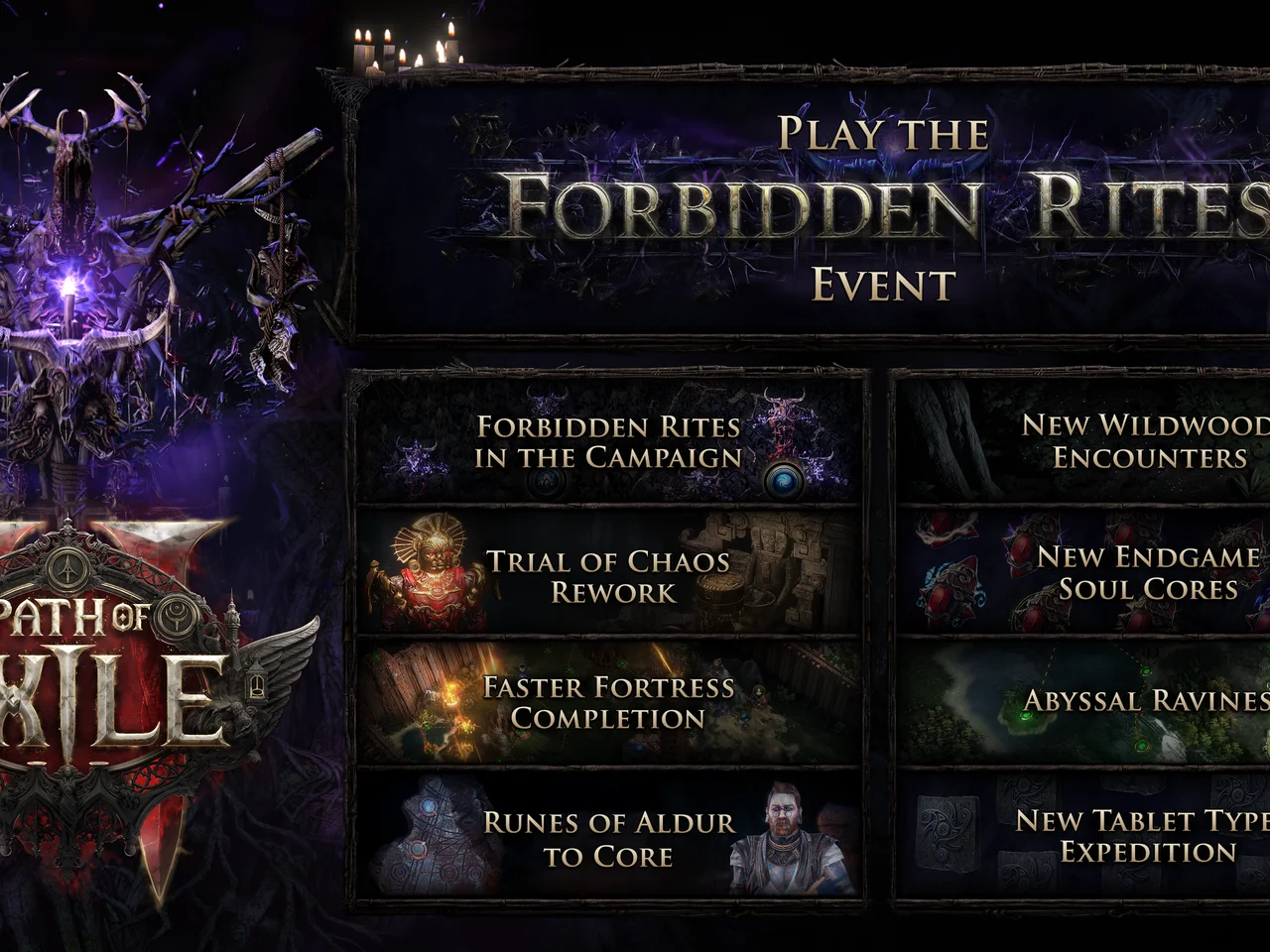
Grinding Gear Games revealed Forbidden Rites on August 27 and clarified its structure in a follow-up FAQ on August 31.
The key point is now unambiguous: this is a new league with separate characters and a fresh economy.
It launches September 4 at 1 PM PDT and remains available until Path of Exile 2 reaches version 1.0 on December 11.
Putting Ritual in every campaign area changes its purpose
Ritual is normally an activity players encounter periodically.
Forbidden Rites makes it part of every campaign zone.
The familiar structure remains. Players kill enemies around an effigy, activate the Ritual and fight resurrected monsters inside the encounter.
Those kills generate Tribute, which is spent on the reward window.
Frequency is what changes the design.
When the system appears throughout leveling, Ritual stops being an occasional diversion and becomes one of the player's regular gearing tools.
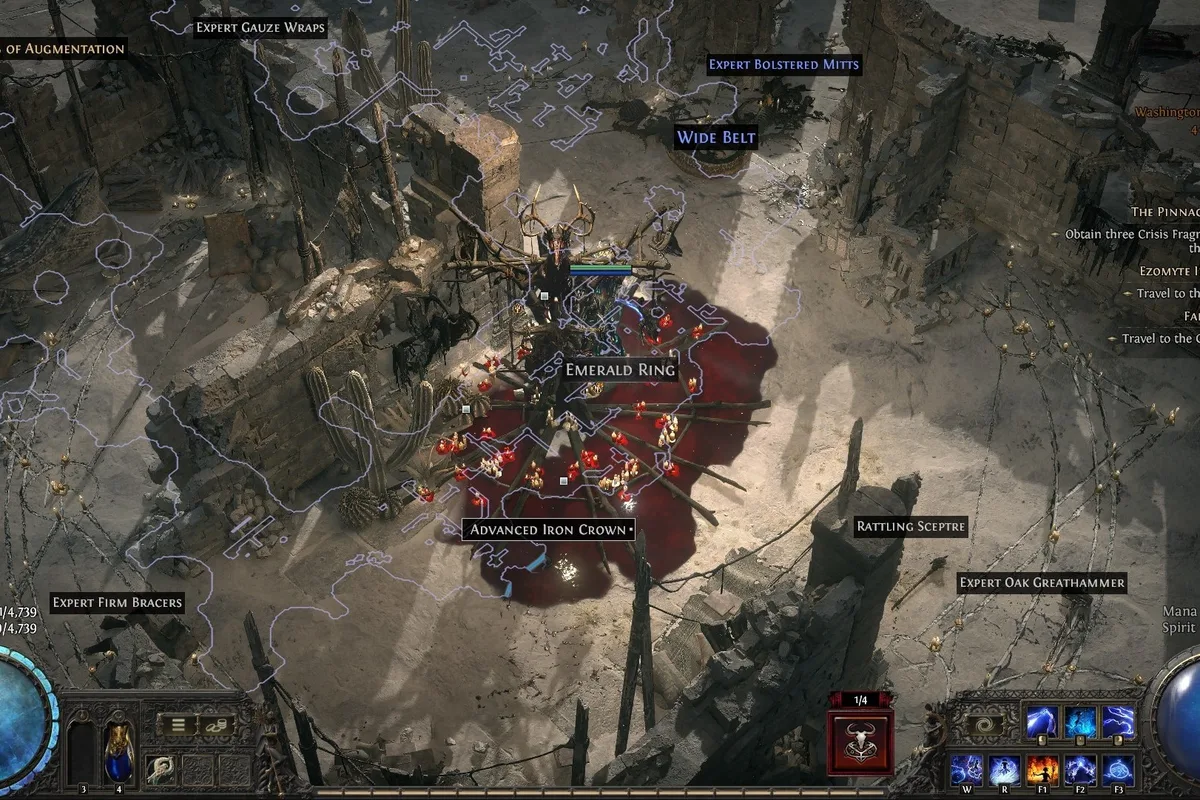
Campaign bosses can become part of later Ritual fights
Forbidden Rites becomes more unusual when boss arenas enter the chain.
Grinding Gear Games has shown Ritual encounters associated with campaign bosses, with defeated bosses able to carry forward into subsequent Rituals.
That allows later encounters to combine multiple bosses rather than simply replay another normal monster pack.
The campaign effectively builds its own escalating boss pool as the character progresses.
A fresh economy makes Tribute much more valuable early on
Forbidden Rites does not inherit the established Runes of Aldur market.
Everyone begins again.
That means useful leveling rewards from Ritual can have much greater practical value during the first hours of the league.
GGG has specifically adjusted campaign Ritual rewards to provide more general currency and equipment appropriate to progression.
In a new economy, a useful weapon or resistance upgrade at the right moment can matter more than a technically rarer item that does nothing for the current build.
Party Tribute becomes personal
Forbidden Rites also makes an important group-play adjustment.
Each player earns and spends their own Tribute rather than sharing one reward decision.
That avoids a single player controlling the value of an encounter that the entire party completed.
Because Ritual now appears constantly during the campaign, that is a meaningful quality-of-life change for coordinated leveling groups.
Sacred Bloom takes the mechanic into the Wildwood
The endgame adds another layer.
Sacred Bloom can appear among Ritual rewards and can be applied to an endgame Map to create a Wildwood entrance.
Once inside, players have limited time to follow Wisp trails and collect as much as possible.
Those Wisps return to the original Map and empower its monsters.
Each Wisp type increases danger in a different way
Grinding Gear Games has revealed three main effects.
Primal Wisps can upgrade Normal monsters into Magic monsters. Vivid Wisps add modifiers to Rare enemies. Wild Wisps increase item rarity from monsters.
Different Wisp types can be collected during the same run.
The result is a player-controlled difficulty multiplier layered on top of existing Map modifiers.
That is classic Path of Exile design: voluntarily create a worse problem because the loot at the other end might justify it.
The fourth Sacred Wisp is still a secret
GGG has also shown a rarer Sacred Wisp.
Its existence is confirmed, but its mechanical effect has deliberately not been explained before launch.
Any claim that it affects bosses, quantity or another specific reward category would therefore be speculation at this stage.
Atlas investment can push Wisp farming further
Ritual Tablets can also interact with the Wildwood system, including modifiers that affect how many Wisps are available.
That allows players to invest into the mechanic rather than treating Sacred Bloom as an occasional bonus.
The strategic question becomes familiar: at what point does adding more reward multipliers make a Map too slow or too dangerous to remain efficient?
Only eight challenges, but almost one hundred days to complete them
Forbidden Rites comes with eight event challenges.
GGG has already highlighted goals such as completing campaign Rituals, defeating named Rare monsters and reaching level 90.
Four exclusive cosmetic rewards are confirmed: Locust Footprints Effect, Locust Swarm Finisher Effect, Wildwood Guardian Pet and Wildwood Affliction Level-up Effect.
A commemorative Hideout Statue also progresses alongside the challenge track.
The compact challenge list initially led some observers to assume the event would only last a few weeks. GGG's FAQ ruled that out.
Forbidden Rites runs for 98 days
September 4 to December 11 gives the league 98 days.
That is enough time for a real economy to mature, farming strategies to stabilize and endgame builds to emerge.
Runes of Aldur remains online during the same period.
Players can therefore finish existing characters there or move into the fresh Forbidden Rites economy.
Patch 0.5.5 contains major changes that are not exclusive to the league
Forbidden Rites should not be confused with every feature in update 0.5.5.
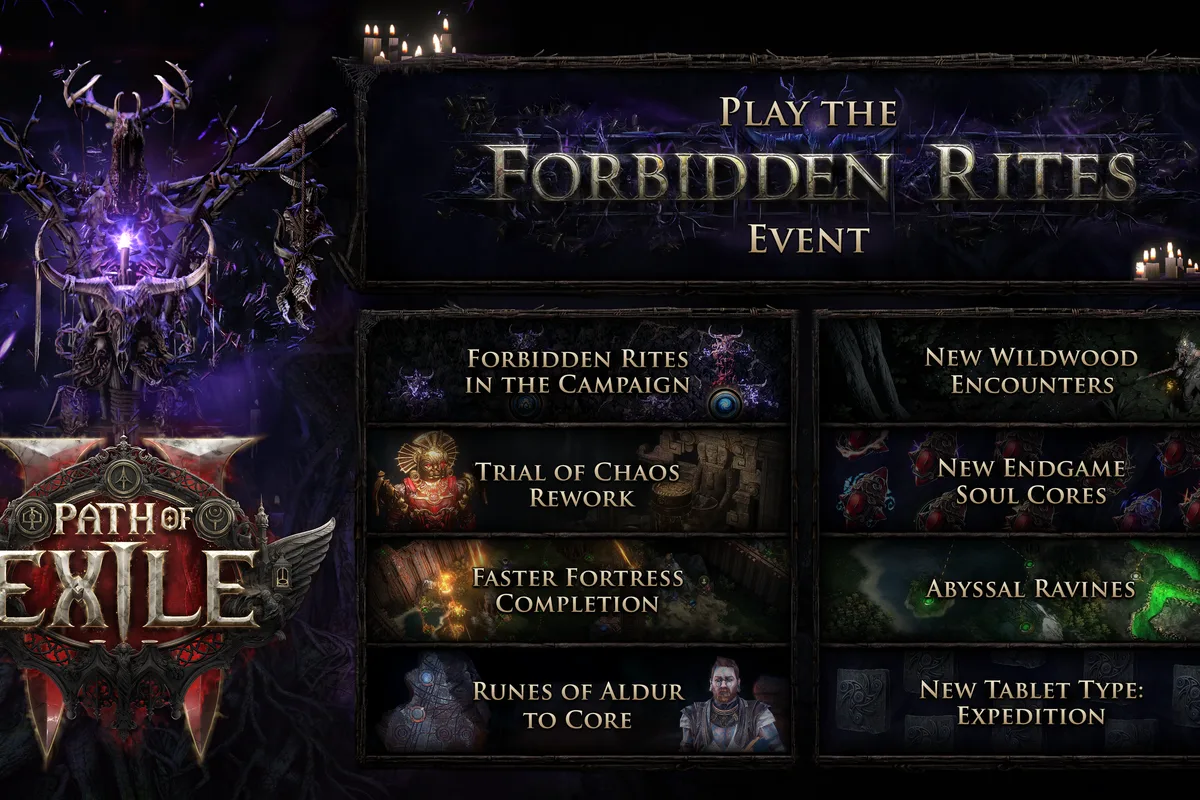
The Trial of Chaos overhaul, Abyssal Ravines, Fortress changes and the permanent integration of parts of Runes of Aldur are game-wide changes.
They also apply to Runes of Aldur and Standard.
Trial of Chaos runs can now be paused between rooms, several specialized objectives are being replaced by straightforward combat encounters, and endgame Trials can extend to thirty rooms with new Wager Modifiers.
There is no giant balance reset attached to the new economy
Grinding Gear Games has also been clear about what 0.5.5 does not contain.
Large skill, passive-tree and Unique-item balance changes previously considered for this update have been pushed to version 1.0.
Forbidden Rites therefore resets the economy without deliberately demolishing the current 0.5 build landscape.
Its biggest metagame disruption may instead come from the constant availability of Ritual rewards and the new ways players can juice endgame Maps.
Forbidden Rites looks increasingly like a final 1.0 laboratory
The returning Wildwood is only part of the story.
For more than three months, Grinding Gear Games will be able to watch what happens when Ritual becomes a permanent part of campaign progression inside a clean economy.
When do players stop engaging with it? Which rewards distort early progression? How much Wisp empowerment remains profitable before clear speed collapses?
A 98-day league can answer those questions far better than a short weekend event.
When Forbidden Rites ends, Early Access ends with it.
That makes this fresh economy less of a distraction before 1.0 and more of Path of Exile 2's final large-scale stress test.