
News News Official
Legacy Code lets you attach dentures to a television and asks physics to figure out the rest
There is probably a perfectly good reason televisions do not have four legs, a set of dentures and a cactus attached to them. Legacy Code is not interested in hearing it. Room 127's debut is built around impossible creatures that its proprietary physics technology then has to somehow make walk, crawl and fight.
 By Kader Legacy Code
Kodansha Game Lab has opened the Steam page for Legacy Code and confirmed a 2027 release window. It is being developed by Room 127, an independent Japanese creator who has spent years experimenting with mechanical creatures and a custom physical-animation system.
Those creatures are called Mechanimals.
A body can begin with almost anything
Legacy Code supports familiar construction pieces such as heads, arms, legs and motors, but the component list quickly becomes less reasonable. A television can become a torso. Electric fans, dentures, chains, character merchandise, puzzles and cacti can all become anatomy.

Every part has its own physical characteristics and movement quirks. The final shape is therefore not merely cosmetic. More legs can improve support, longer limbs can change reach and heavier objects can alter how the entire creature moves.
Or the thing may simply drag itself sideways in a way nobody expected. That counts too.
The Marionette Engine has to animate impossible anatomy
Room 127 built its own Marionette Engine for the project. Rather than selecting a conventional animation appropriate for a predefined character skeleton, the system attempts to determine how the particular object assembled by the player can move.
That unpredictability is presented as a core part of the experience. A Mechanimal designed to walk elegantly may discover a considerably stranger method of locomotion once physics takes over.
Programmer Yasuta says the team deliberately tried to create combinations capable of breaking the system, only to find that each configuration still produced something that behaved like a living creature.
Building is only one third of the loop
Legacy Code is structured around building, fighting and collecting.
After construction, the player directly controls the Mechanimal through environments including deserts, snowy mountains and ruins. Other creatures become both enemies and potential sources of new anatomy.
Defeating them provides experience and parts. Those components can then be attached to the existing body before returning to the world.
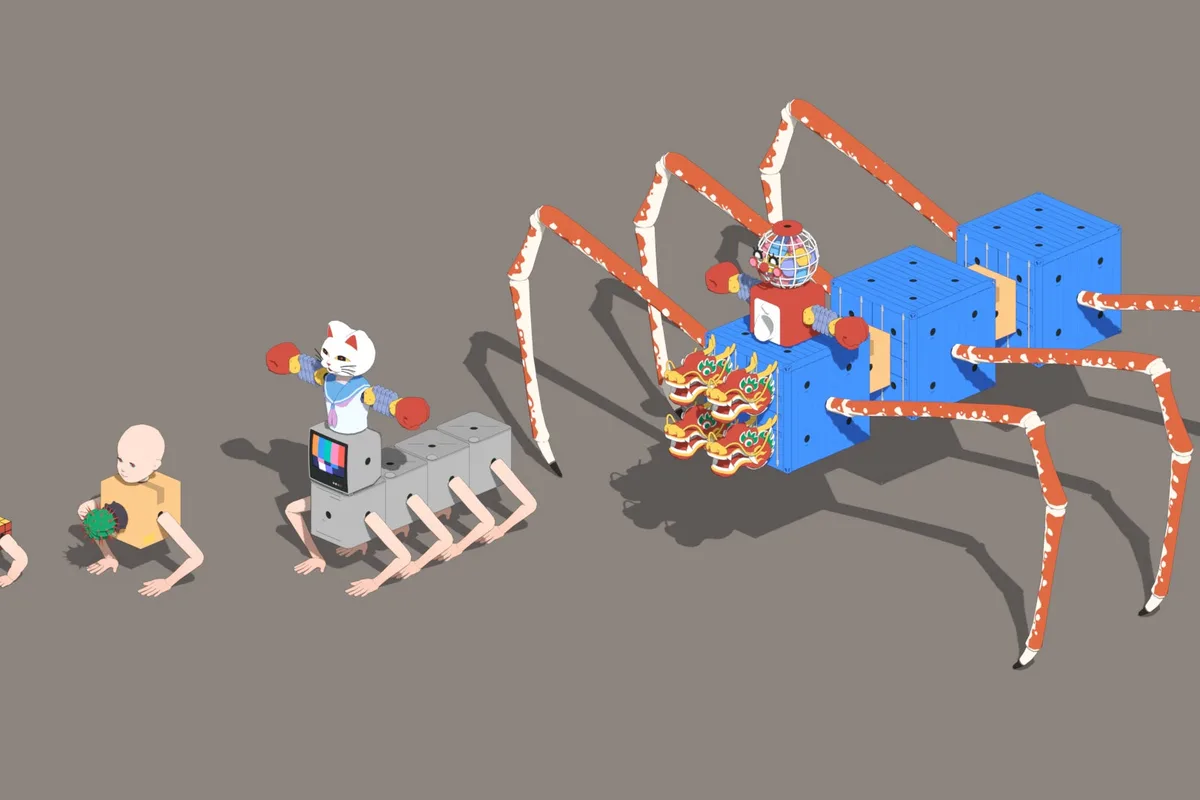
Progression makes the creature physically larger
Growth is not confined to a statistic screen. Mechanimals visibly become larger as more pieces are attached.
Additional legs can support a heavier construction, longer arms change physical reach and stronger parts allow the creature to challenge enemies that were previously too dangerous.
That growth also expands where the player can travel.
Tokyo Game Show noticed exactly how difficult the idea is to describe normally
Legacy Code was selected as one of eight finalists for Sense of Wonder Night 2026 at Tokyo Game Show. Kodansha says more than 1,500 projects entered the broader selection process.
It did not win the Audience Award Grand Prix, which went to Face UFO, but its inclusion fits the event's emphasis on experimental game concepts built around unexpected technology and design.
The latest build is also playable at the Kodansha Game Lab booth during TGS 2026.
Steam in 2027, and no other platform is announced
Legacy Code is currently confirmed only for PC through Steam. It is a single-player game with Japanese, English and Simplified Chinese interface support announced.
There is no exact release date or price yet.
Room 127 therefore still has time to answer a question games have somehow ignored for decades: how many legs does a television need before it becomes a predator?