
Review
BOMBANANA!: three players, three information gaps, one excellent co-op design

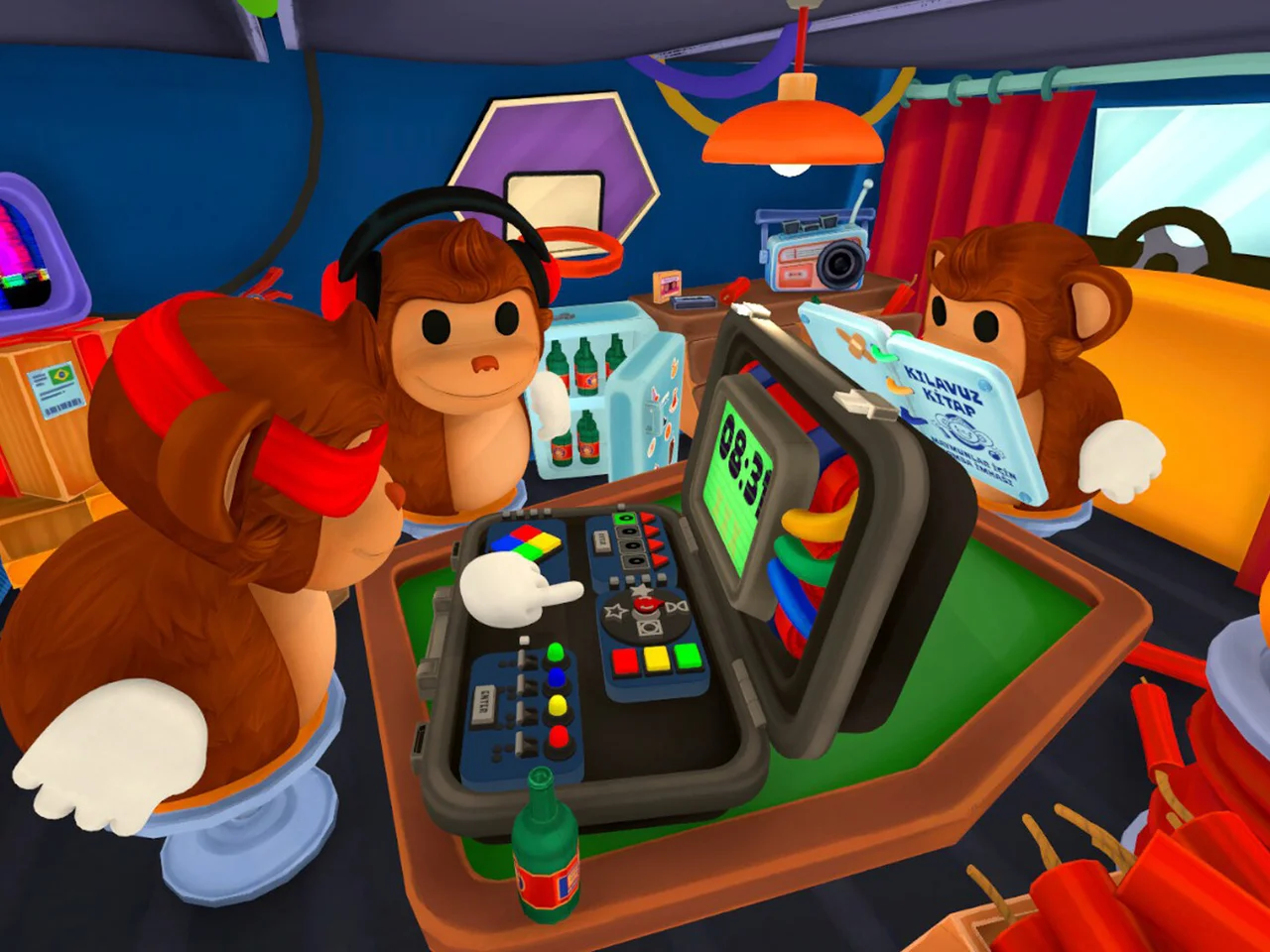
BOMBANANA! takes the familiar bomb-and-manual setup and breaks the information chain into three incompatible roles. Communication itself becomes the puzzle. Thirty campaign levels, Endless mode and Custom challenges give the idea enough structure to survive beyond its viral first impression, even if onboarding and accessibility remain genuine weaknesses.
Information is the resource
BOMBANANA! looks like a bomb-solving game, but its most important resource is neither time nor mistakes. It is information. Each clue begins in the wrong hands and has to survive a relay before anyone can act on it.
Blind physically operates the device without normal visual access. Mute owns the manual but loses ordinary speech. Deaf can observe both the bomb and the frantic body language around it while hearing none of the team's voice communication. The system works because the restrictions overlap without making any one role expendable.
Teams build a language before they build mastery
The first successful runs are rarely elegant. Gaming.net and other full-release reviews repeatedly describe groups fumbling through gestures, incomplete descriptions and contradictory instructions before eventually discovering procedures that work.
That discovery is the real skill curve. A good trio standardizes perspective, confirms information before acting and learns which details must be transmitted immediately. A bad trio shouts more loudly at the player who cannot hear them. Both are technically playing the same level.
This is also why failure is unusually productive. An explosion often has an identifiable conversational cause. The next attempt becomes a revision of the team's protocol rather than a simple replay of the same puzzle.
The full release gives the gimmick somewhere to go
A viral demo premise could easily have ended as a one-evening joke. The released game avoids that trap with a 30-level Campaign, procedural Endless mode and a Custom builder. The Campaign teaches new problems in a controlled sequence; Endless asks whether a team's communication habits survive unpredictable combinations; Custom lets players isolate the exact thing they keep misunderstanding.
Role rotation adds another layer. A module already solved several times can feel unfamiliar from the other side of the information chain. Knowing the answer and being able to communicate that answer are entirely different competencies here.
Matchmaking helps, chemistry matters more
Version 1.0.2 added matchmaking, a necessary improvement for a game built around an exact trio. It reduces the organizational burden but cannot manufacture the relationship that makes the design shine.
BOMBANANA! becomes better as a group develops shorthand, trust and an understanding of each other's panic responses. That dependence makes it less flexible than many co-op games, and some players will reasonably dislike needing such a specific social setup.
For the intended audience, however, the limitation is the point. The game does not ask whether one smart player can solve the bomb. It asks whether three incomplete players can become one competent system before the timer reaches zero.
Strengths
- Role asymmetry genuinely changes how information moves through the team
- Failure naturally becomes comedy instead of simple punishment
- The 30-level Campaign steadily expands the communication problem
- Endless and Custom modes give skilled groups meaningful reasons to continue
- Swapping roles changes the same puzzle into a different cognitive task
- Version 1.0.2 added matchmaking and rebalanced difficulty
Weaknesses
- The quality of a session depends heavily on the people in the trio
- New modules can be difficult to understand cleanly on the first attempt
- The Mute role's gesture vocabulary can become restrictive as instructions grow more complex
- Voice dependence creates real accessibility gaps
- Early failures can feel arbitrary until the group develops a shared language
BOMBANANA! has the defining quality of strong cooperative design: remove one player and the entire system collapses. Blind can operate but not see, Mute understands the manual but cannot explain it verbally, and Deaf becomes the visual relay without access to the team's voices. The bomb is almost secondary; the real progression is the language a trio invents together. Accessibility gaps and intentionally rough first encounters keep the design from being universally welcoming, but with the right three people it is an unusually clean mechanical idea disguised as complete chaos.