
News News Official
Acer hits 1000Hz at full 1080p with the Predator XB253Q U1
A few years ago, 360Hz already sounded excessive outside professional esports. Acer has now pushed its Predator XB253Q U1 to 1000Hz without dropping the resolution to 720p. The new monitor runs its full 1920 × 1080 panel at the headline refresh rate.
 By Nolind
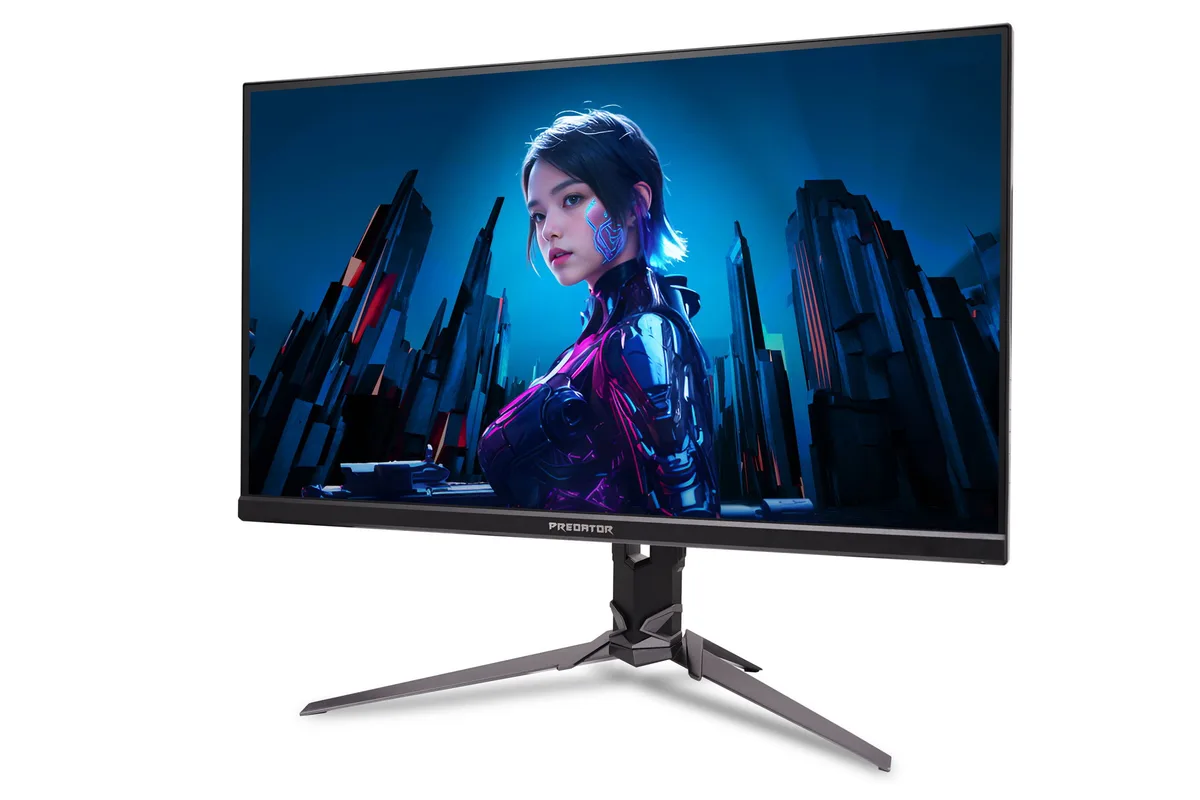
Acer announced the Predator XB253Q U1 at IFA 2026 on September 2. It uses a matte 24.5-inch IPS panel with a native 1920 × 1080 resolution and a maximum refresh rate of 1000Hz.
The size tells you almost everything about the intended customer. Compact 24- to 25-inch displays remain common in competitive gaming, where keeping the entire screen comfortably visible matters more than filling a desk with a cinematic panel.
1000Hz means a one-millisecond refresh interval
At 1000Hz, the display can begin a new refresh every 1ms. A 500Hz screen works at 2ms intervals, while 240Hz corresponds to roughly 4.17ms.
That is not the same as saying every player suddenly receives a dramatic fourfold improvement over a 240Hz monitor. Rendering performance, game engine behavior, input latency and pixel response all remain part of the chain.
The obvious workloads are esports titles capable of running at extremely high frame rates. This is hardware for Counter-Strike 2 and Valorant far more than a display designed to make a 60fps cinematic game look transformative.
VRB Pro attacks motion blur as well as refresh rate
Acer combines the panel with Visual Response Boost Pro and quotes a 0.3ms response time in that mode. VRB Pro is intended to reduce perceived motion blur and ghosting, making rapidly moving targets easier to track.
The wording matters. That 0.3ms figure is attached to Acer's VRB Pro specification rather than being an independent measurement of every pixel transition. Proper testing will be needed to establish real response behavior, overshoot and motion clarity at the extreme refresh setting.
AMD FreeSync Premium and NVIDIA G-SYNC Compatible support are included.
1080p is the compromise, not an oversight
A €1,099 monitor with a Full HD resolution looks peculiar if resolution is the first specification you normally check. The XB253Q U1 is not built around pixel density, however. Its entire point is maximizing temporal resolution.
Higher spatial resolution would also multiply the rendering workload at exactly the moment Acer wants a gaming PC to deliver hundreds of frames every second.
The panel is specified for 99% sRGB and 90% DCI-P3 coverage, using 8-bit + FRC color. Acer lists 400 nits of native brightness and a 450-nit peak in its HDR400 mode.
DisplayPort 2.1 is on the back
Connectivity consists of two HDMI 2.1 ports and one DisplayPort 2.1 input. The stand supports 150mm of height adjustment as well as tilt, swivel and pivot. There are no integrated speakers.
Acer also highlights Circular Polarizer technology. The company says its approach changes the polarization of emitted light to more closely resemble characteristics associated with natural light, with the aim of reducing glare and visual fatigue.
That claim will be much more interesting once independent testing can compare it with conventional gaming panels.
The price is almost one euro per hertz
The Predator XB253Q U1 is scheduled for Europe in the first quarter of 2027 starting at €1,099. North American pricing begins at $1,099.99 during the same quarter.
Acer is entering an increasingly strange high-refresh-rate race. LG already has a native 1000Hz UltraGear model, while Samsung has pushed another gaming display to 1100Hz.
The next useful question is no longer whether manufacturers can put four digits on the specification sheet. It is how much measurable competitive benefit remains between an already extremely fast 500Hz-class display and 1000Hz.